BP Engineer Kurt Mix and the ‘Ham Sandwich’ Indictment

On May 2, 2012, just over two years after the catastrophic explosion on the Deepwater Horizon drilling rig, BP drilling engineer Kurt Mix was indicted on felony charges. Mix’s deletion of of text messages and voicemails from his cell phone, according to federal prosecutors, amounted to an obstruction of justice in the investigation of the BP spill.

But to Mix’s attorney Joan McPhee and Forbes contributor Walter Pavlo, the Mix prosecutors are a case of “Prosecutors Gone Wild“, overcome by their zeal to convict someone, anyone, as a scapegoat in the record-setting environmental disaster.

Prosecutors felt that Mix had deleted information that was critical to calculating the flow of oil into the Gulf, something that would later be used to determine BP’s spill liability.   A superseding indictment charged that Mix had also deleted three voicemails on the same phone to the CONTRACTOR. …

Note that Mix is not accused of covering up evidence of his, or even his employer’s, culpability in the blowout. Mix was not the engineer in charge of the well at the time of the accident. Mix was brought in to help with the “kill procedure”, the effort to halt the well’s uncontrolled flow. The information prosecutors accuse him of deleting bears only on the size of the fine the Feds can slap on BP.* It was never needed to find out why the well failed, or how to save lives in the future.

McPhee sought to have one of the counts against Mix thrown out last November when it was discovered that the text messages in question contained innocuous messages about things such as lunch plans and yoga lessons … not oil spill calculations.  During that hearing, U.S. District Judge Stanwood R. Duval, Jr. noted that the messages did not represent, “an overwhelmingly strong indictment.”  Prosecutors said that the messages, particularly those related to lunch plans, could be ‘nuances’ about something more sinister.  Nevertheless, a ruling was made to allow the count to stand pending receipt of further information.

It was 16 months after the indictment, April 2013, when prosecutors were forced to disclose that the contractor who participated in the deleted exchanges gave the FBI a statement that it engaged in no technical discussions with Mix, or had any dialogue with him concerning the well’s flow rates. Furthermore, the prosecution plans to call neither the contractor nor Mix’s BP supervisor (the other subject of deleted communications) in his December trial.

The Grand Jury’s indictment depended on FBI testimony that a) Mix received several “legal hold notices” not to destroy communications and b) that Mix subsequently deleted the text message threads and voicemails.

But the Grand Jury was never told that the “legal hold notices” were statements of BP document retention policy, not federal law. The Grand Jury was not told the content of those deleted communications, even though they requested the information. Prosecutorial bluster seems to have won the day.

In order to strengthen their case against Mix, prosecutors further accused Mix of misleading former Secretary of Energy Steven Chu in a technical slideshow. It was presented in a meeting without Mix in attendance and without his knowledge. The only reference to Mix in the entire presentation are some engineering calculations attributed to him — with his first name misspelled.

It sounds as though the government’s case against engineer Kurt Mix is exceedingly flimsy. If convicted, he is facing not just professional and financial ruin but potentially many years in prison. Any technical person who works in oil and gas, or for that matter in coal, nuclear power, chemicals, pipelines, or any other industry with similar accident potential, needs to ponder the implications of their involvement, and what might be their response in an accident. As Mix’s attorney Joan McPhee stated in her response to the government’s allegations:

“If these sorts of prosecutorial tactics were given any credence, when the next environmental disaster strikes, individuals with the knowledge and skill to respond to the disaster would be better off just leaving the building, lest they later be baselessly accused of fraud.”

This echoes what I wrote while the Macondo spill was ongoing — at the time, Interior Secretary Ken Salazar and his offshore safety chief (and ex-prosecutor) Michael Bromwich seemed more focused on assigning blame than in stopping the well’s flow (remember “cozy relationship“?). Through fear and accusation they alienated some of the only technical professionals within government and industry who could help solve the disaster.

Let’s face it: Government has become so big and so powerful that it can crush any one of us like a grape if it chooses. And it seems more inclined to do so with each passing day.

* Under the Clean Water Act, BP’s fine can range from $1,100 per barrel spilled up to $4,300 per barrel, if it is determined that gross negligence led to the spill. The government estimates 4.9 million barrels spilled, vs. BP’s estimate of 3.26 million barrels. BP’s total exposure to this fine alone is almost $18 billion (they won’t pay for some 800 thousand barrels recovered). The difference in volume estimates could be worth $7.3 billion. (Source.)


Cross-posted.

Posted in BP Spill, Government | 1 Comment
Pakistani Government / AFP / Getty Images

Pakistani Government / AFP / Getty Images

A new land mass formed off Pakistan as a result of the recent earthquake. Press reports, um, diverge as to the actual size and location of the new island. Granted, most of these estimates are based on eyewitness reports, but the variation is pretty comical. Continue reading

Posted on by Steve Maley | 3 Comments

Let’s play Name! That! Party! #AP #rsrh

NEW ORLEANS (AP) — Court documents show former State Rep. Girod Jackson III, who resigned his seat after being charged with tax fraud involving his bankrupt construction company, will plead guilty in federal court next month.Jackson was charged in August with making fraudulent statements on a tax return and failure to file tax returns. At his initial arraignment earlier this month, Jackson pleaded not guilty.

Jackson had indicated he would not fight the government’s charges. He is set to be re-arraigned before U.S. District Judge Jane Triche Milazzo on Oct. 10.

Answer here.

"The best surprise is no surprise." – Holiday Inn

Posted in Uncategorized | Leave a comment

I don’t walk out of movies, as a general rule. Today, I made an exception.

Hoo, boy, is The Family a piece of crap.

MV5BMjE2MzI0MzkyNV5BMl5BanBnXkFtZTcwMjQ2MDM2OQ@@._V1_SX214_

By way of background, Martin Scorcese is my favorite director. (He’s executive producer here. Directed by Luc Besson.) Robert DeNiro and Michelle Pfeiffer are two of my favorite actors. Tommy Lee Jones supports. I’m nuts for mob movies – Goodfellas, Casino, two of the Godfather movies, even Married to the Mob.

But this one is just a flippin’ mess.

It’s billed as a comedy, but it has its share of gratuitous violence. The plot features an American family of four on the run in Normandy (?!) because the dad (DeNiro) ratted out his former associates. Jones plays their FBI contact for the witness protection program.

The trouble is, Mom, Dad, Junior and Sis are all sociopaths who exact violent revenge for the slightest insult. At some level, for this to be “funny”, shouldn’t we want to identify with them? Shouldn’t they have some redeeming qualities?

Save your money.

Posted in Uncategorized | Leave a comment

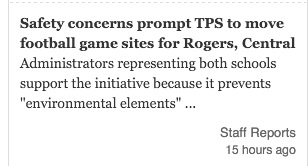
Tulsa Officials Cite ‘Environmental’ Reasons for Moving Football Games. Wait, what?

Tulsa Public Schools administrators moved the venue for two high schools’ future home football games. It’s for the children, after all.

Tulsa World Headline

Oh, my gosh. We certainly would not want to expose student-athletes to “environmental elements”. The mind reels as it imagines a football pitch-cum-Love Canal poisoned with pesticides, herbicides or  (G_d forbid) “fracking chemicals“.

As it turns out, this particular football suffered from environmental contamination, alright: a potentially lethal combination of charcoal, sulfur, saltpeter and lead.

[Eighteen year old Dominique] Morgan … attempted to enter the Central High School vs. Springdale, Ark., football game at S.E. Williams Stadium while wearing a backpack but was denied entry with the backpack by Tulsa Public Schools police officers, according an arrest report.

After he then left the backpack nearby and entered the stadium, police searched the backpack and found a sawed-off shotgun in it, police alleged. …

Administrators representing both schools [Central and Rogers] support the initiative because it prevents “environmental elements” from potentially disrupting events, said [TPS Athletic Director Gil] Cloud.

“Environmental elements”? Seriously? That’s the kind of blamelessly passive response to a serious threat that we’ve come to expect from today’s “professional educators”. The only thing wrong with the environment at S.E. Williams Stadium is that it contains thugs with guns.

Cross-posted.

Posted in Environment | Leave a comment

Sal and Judy’s

Paula and I had the pleasure of dining at Sal and Judy’s in Lacombe, LA, about halfway between Mandeville and Slidell on the Northshore. It’s been about 20 years since we last ate there.

Paula had the speckled trout almandine with what must have been half a pound of beautiful lump crab meat. I had veal cannelloni at our server’s suggestion.

Scrumptious.

They get every detail right, including the service.

They have expanded the dining room since we last ate there (it started as a repurposed filling station). Same Sinatra music, though.

Two memorable dishes from years past are still on the menu: the fried chicken was maybe the best I’ve ever had. And the spaghetti and oysters were remarkable — Even better left over!

Posted in Uncategorized | Leave a comment

#Seinfeld was #raaacist. Who knew? #rsrh

Screen detail from the “Good Samaritan” episode (1992). That’s the one in which George says “God bless you” after a married woman sneezes (and subsequently has an affair with her), and Kramer has seizures triggered by Mary Hart’s voice.

“You are soooo good looking!

Update: From this morning’s Daily Caller . . .

The ‘Yadda Yadda Yadda’ Doctrine: How Obama’s Syria strategy is like Seinfeld

Read more:
Posted in Uncategorized | Leave a comment

‘The President’s All-of-the-Above Energy Strategy’ and Other Self-Delusions

We’ve been having area-wide lease sales over the same portions of the Gulf of Mexico for the last 30 years. Despite this week’s tepid response at the Western GoM Sale (shelf and deepwater offshore Texas, mostly), the press release from the Bureau of Ocean Energy Management would have you thinking it was a smashing success.

Western Gulf of Mexico Lease Sale Yields $102.4 Million in High Bids on More Than 300,000 Acres

As part of President Obama’s all-of-the-above energy strategy to continue to expand safe and responsible domestic energy production, the Department of the Interior’s Bureau of Ocean Energy Management today held Western Gulf of Mexico Lease Sale 233, . . . [blah, blah, blah & etc.]

But the Oil and Gas Journal cuts through the self-congratulatory baloney:

Lackluster western gulf lease sale draws $102 million in bids

The US Bureau of Ocean Energy Management’s western Gulf of Mexico Lease Sale 233 offshore Texas netted $102,351,712 in apparent high bids—less than the first two sales in the Obama administration’s Outer Continental Shelf oil and gas leasing program for 2012–17.

Twelve offshore companies submitted 61 bids for 53 tracts covering 301,006 acres. Nearly 21 million acres were available for oil and natural gas exploration and development.

It was even worse than that. Two adjoining blocks accounted for fully 50% of the total high bids. Almost all of the action was in deepwater, and few blocks drew bids that substantially exceeded the minimum bid level. Only four, count ’em four, shelf blocks drew any bidding attention at all.

In fairness, the shelf in the Western Gulf is gas-prone, and gas prices are historically low compared to oil. But industry’s tepid response to the sale also reflects concern about Interior’s increasingly stifling and costly approach to regulation.

Also this week we were graced with a blog post from White House economic advisors Jason Furman and Gene Sperling (AFAIK no relation to the Hair Club for Men guy). The thrust of it is taking credit for the positive impact that the energy sector has had on GDP growth, the balance of trade and on job creation. I’ll only comment about a couple of their more noteworthy claims, which have become talking points for the Administration:

The President established a national goal in 2011 to reduce oil imports by one third by 2020 and elevated the goal in 2012 to reduce them by one half by 2020. We are currently on track to meet this ambitious goal if we continue to follow through on the policies that are critical to achieving it.

That’s accompanied by this graph:

EIA overviewWhich is an example of what we know as Vladimir’s First Law of Graphs:

Whenever someone shows you a graph with a y-axis that starts at a value other than zero-point-zero, they’re trying to sell you a bill of goods.

Here comes the part where they try to glom credit for the unprecedented growth in oil production since 2009:

Government funded research supplemented private industry’s work to develop the technology that sparked the boom in oil and gas production. Crude oil production has grown each year the President has been in office to its highest level in 17 years in 2012 (see chart above). In fact, over the past four years, domestic oil supply growth has accounted for over one-third of global oil production growth.

None of the statements in that paragraph are demonstrably false, but they are stated in a way to suggest that somehow the boom would not have happened without government support, and that Obama is its biggest cheerleader. This is a classic example of the Post Hoc fallacy. Saying the government deserves credit for the shale boom is like saying that Noah deserves credit for discovering the New World* in 1492 due to his pioneering research in marine architecture.

We are often reminded that petroleum development often take years. In other words, “You didn’t build that”, Mr. President.

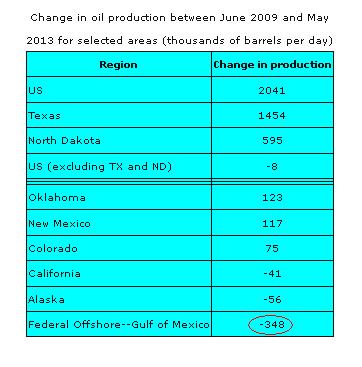
A recent excellent blog post at Econbrowser makes the rather surprising observation that

Interestingly, two states– Texas and North Dakota– account for more than 100% of the increase in U.S. production since 2009.

This rather counter-intuitive statement is true because the production gains in all the other states cannot offset the 348,000 barrel per day loss in production from the Federal Offshore since 2009. I’ll steal Econbrowser’s table to make that point:

Oil Prod tableI credit the oil boom to three things:

  • Favorable geology in the Bakken (ND) and Eagle Ford (TX) formations;
  • Greedy entrepreneurs cleverly exploiting high sustained crude oil prices (that’s known as capitalism);
  • State governments who understand the economic benefit of energy development, and actually facilitate it with responsible and effective regulatory policies, rather than choking it with unnecessary regulation.

Cross-posted.

* Too Euro-centric?

Posted in Energy | Leave a comment

Long before the Selmon Brothers, #OU Football had the Terrible Hotts. #rsrh

Brothers Sabert, Oliver and Willis Hott of Medford, OK were teammates in 1913. The 100th anniversary of that season is commemorated on the ticket for OU’s 2013 opening game against the U of Louisiana – Monroe.

Sabert played from 1910-13. Family legend has it that he would remove his glass eye and let the opposing linemen have a look at its empty socket before every play. Willis and Oliver played 1913-16.

The three played for legendary coach Bennie Owen. The team photo below shows the undefeated 1915 squad.

Posted in Uncategorized | Leave a comment

The Bayou Corne Sinkhole, Part II: What’s Really Going On

aquitardIn Part I: Ridiculing the Press, we looked at press coverage of the Bayou Corne Sinkhole, an ongoing environmental incident in Assumption Parish, Louisiana. That coverage has ranged from indifferent to uninformed to inflammatory. I decided I had to assess it for myself.

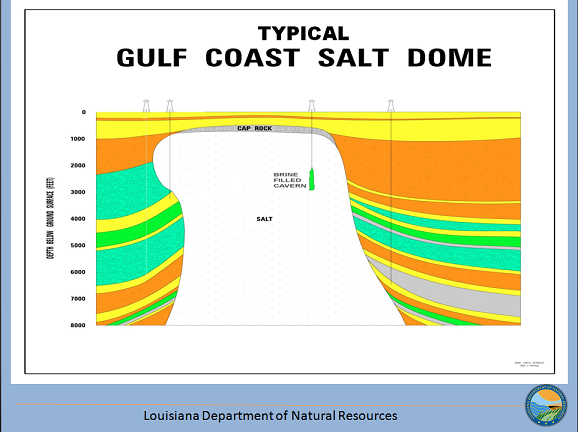
First, it helps to know what a salt dome is:

DNR salt dome

Salt domes are a common feature of the Gulf Coast. The dome itself is composed of solid rock salt. Domes are somewhat cylindrical. They commonly reach almost to the surface (like at Avery Island, the home of Tabasco sauce), while the base of the pillar may be in a salt layer at 20,000 feet or more in depth.

Salt domes are commercially significant. Rock salt is mined in some. The dome structure also provides an ideal trap for oil and gas, so many have oil and gas accumulations on their flanks (depicted in green in the cartoon immediately above).

The salt has an important property: it is massive and nearly pure, and a cavern in it makes a great container, like a big jug. The Department of Energy uses salt dome caverns for its Strategic Petroleum Reserve. Private companies use man-made caverns for industrial storage, often of natural gas or refined petroleum products.

Near Bayou Corne, the Napoleonville Salt Dome hosted several man-made caverns. This sinkhole is the result of the failure of a cavern owned by Texas Brine, LLC, a company based in Houston. The cavern is located on property owned by Occidental Chemical, which consumed produced chloride at a nearby plant.

This cavern was not used for storage. It was a source of saturated salt water and trace minerals that are used in a variety of industrial processes. The injection of fresh water dissolved a cavern inside the solid rock salt pillar. The cavern was up to 300 feet across; the top was at 3,400 feet below the surface and the base was at 5,624 feet.

Operations started in 1982. In 2009, the cavern failed a pressure integrity test (an indication of a minor leak) and mining operations ceased. The cavern was ordered to be abandoned by the Louisiana Department of Natural Resources (DNR). Texas Brine complied in June, 2011.

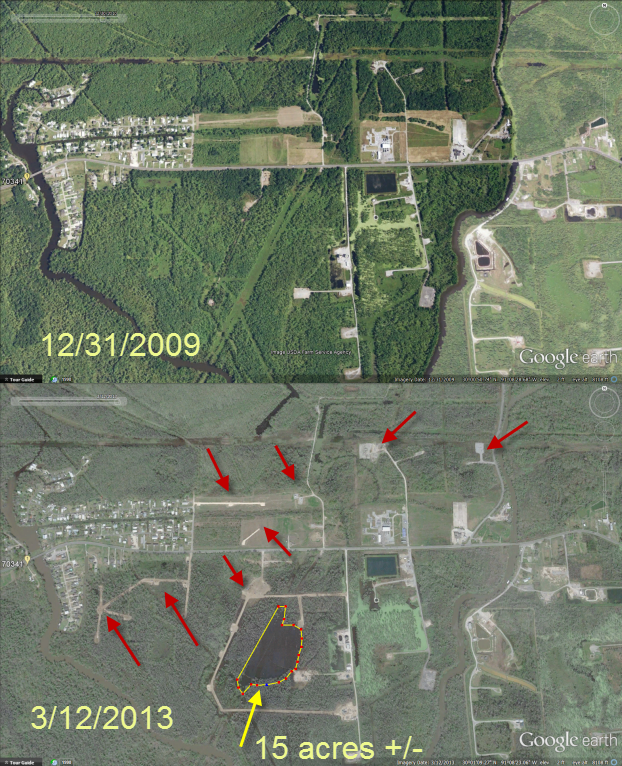
About a year ago, bubbles of unknown origin were reported in the Bayou Corne area. At first, a pipeline leak was expected, but by August a sinkhole formed. About 350 residents of the nearby community of Bayou Corne were evacuated. What started as a few bubbles eventually grew to an unstable 24 acre pond that, as we saw in Part I, continues to suck in land and cypress trees. The Google Earth images below compare “before” and “after”.

BC comparison

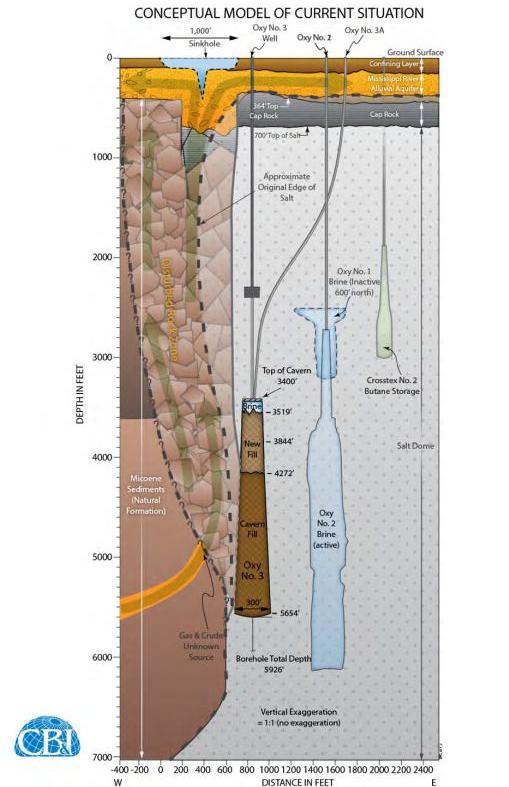
The problem as diagnosed by CB&I, engineering consultants to the DNR, is that the cavern designated “Oxy 3” was constructed too close to the side of the dome. The 1982-vintage subsurface maps showed the salt face sloping away, when in fact there is an apparent overhang.

CB&I’s diagram shows their interpretation of the failure:

CBI edit

This interpretation is not speculation or conjecture. A three-dimensional seismic survey was acquired to image the subsurface in much the way that doctors use MRI’s for internal images of the human body.

It appears that the side wall of the cavern failed. Rubble and debris began to fill the water-filled void of the cavern. A disturbed zone of rock (DRZ in the top diagram) realigned, ultimately reaching the surface and creating the sinkhole. (This is the first documented case of side-wall collapse of a salt cavern. Caverns have failed before, but always through the roof, not the side.)

The environmental calamity here is not that, in the words of Mother Jones’ lurid headline, that the “sinkhole will swallow the town”. Eventually the cavern will fill and stabilize. But the disturbed zone provides a pathway to the surface for small accumulations of fluids that were otherwise static, trapped against the salt. As the diagram shows, they also threaten the Mississippi River Alluvial Aquifer, the shallow freshwater sands that underlie the area. That’s the big problem: gas in the MRAA could pose a safety threat to nearby residents if this leakage were allowed to continue unabated.

The Response

Since the residential evacuation a year ago, Texas Brine has paid each family $875 per week for temporary living expenses. Obviously, the displaced residents’ nerves are frayed. Some permanent buyout offers have been made and accepted.

Without admitting blame, Texas Brine has generally cooperated with DNR requests. Texas Brine has insurance, and DNR deems the coverage to be sufficient. DNR is also acting in response, and will expect to be compensated for its expenditures, plus any penalties that may ultimately be assessed. To that end, on August 2nd the State of Louisiana and Assumption Parish filed suit against Texas Brine and a subsidiary of Occidental Petroleum. (The sinkhole first opened August 3rd a year ago; filing within one year beat the statutory deadline.)

The red arrows on the Google Earth image above, dated 3/12/2013, show some of the environmental response in progress. None of these structures existed prior to the sinkhole. The growth of the sinkhole is primarily to the east, toward the crest of the dome and away from the community.

A recent press release from acting DNR Secretary Stephen Chustz details the response underway:

One well, the Oxy 3-A (see CB&I diagram above) has been drilled to reenter the cavern and assess its status. It has been determined that the cavern is filling with rock at the rate of 1-2 feet per day.

Thirty-nine (of 42 planned) wells have been drilled to vent gas from the shallow aquifer. Sixteen million cubic feet of gas have been vented to date, of an estimated 45 to 50 million cubic feet. (That may sound like a lot of gas, but in industry terms, it’s not. A typical commercial gas well would produce ten to one hundred times more gas in its lifetime.)

Thirty wells have been drilled to monitor water quality and pressure.

Three wells have been drilled for the purpose of monitoring seismic activity. Four subsurface surveys have been run to monitor the salt face. A 3-D seismic survey has been run and is being independently evaluated. It is being used to define the spatial configuration of the salt and the zone of disturbed rock.

Air quality is continuously monitored. Ground surveys monitor subsidence. Oil skimming operations at the sinkhole recover the oil on the surface, which leaks at a rate of a few gallons a day.

Et cetera.

In addition, external experts have been engaged to assess the data gathered. These include Federal agencies (DoE, Interior, EPA); more than two dozen contractors and consultants; and a blue-ribbon commission made up of world-class experts in salt domes, solution mining, gas migration and so on from Sandia Labs, Canada and Europe.

What the Future Holds

It seems likely that the sinkhole will stabilize once the cavern is full. The cavern is a finite volume, and once it is full, it’s full. (In other words, citizenkh, it will never connect to the Macondo blowout, the New Madrid fault, or China. I promise.) Whether Bayou Corne will be habitable will depend on the effectiveness of the response and cleanup.

If my cipherin’ is correct, a cylinder a 2254 feet long and 250′ average diameter would have a volume of about 4.2 million cubic yards. That’s probably a high-side estimate of its capacity.

CB&I estimated that the volume of the sinkhole reached 2.0 million yards by June 2013. More importantly, soundings indicated the cavern was about 2/3 full.

So we may have continued seismic activity and occasional dramatic videos of trees disappearing for a while longer — maybe six months? Who knows. Gradually, though, it will stop.

As I suggested previously, the leakage of gas, oil and water may continue for some time, and that’s the bigger environmental concern. Gas recovery activities will have to continue until the excess gas in the MRAA is gone. Surface monitoring and collection of oil seepage will have to continue, perhaps indefinitely.

Conclusion

When I started researching this for this series, I was skeptical that the response was adequate or that sufficient resources were being dedicated to the problem to contain it. I have learned that the failure mechanism is reasonably well understood and that safeguards are in place to minimize the potential for lasting environmental damage.

Industrial accidents are never a good thing. Unfortunately, just as we accept a low level of risk when we travel by plane, boat or car, our modern lifestyles and standards of living rely heavily on petrochemicals and other natural resources. In satisfying our demand, industry creates risk to people and to the environment. The risk level is comparatively low, but never, ever zero. As citizens in this economy, it is good that we be aware of our dependence and our collective assumed risk.

Otherwise, we’ll be as lacking in self-awareness as these anti-fracking ninnies in the U.K. (from wattsupwiththat.com).

Cross-posted.

Posted in Environment, Louisiana | Leave a comment