S. Baldwin v. K. Costner in oil-cleanup lawsuit. #rsrh #rootforinjuries

Costner, Baldwin in court over oil cleanup devices

Actors Kevin Costner and Stephen Baldwin opened a real-life legal drama on Monday as jury selection began in a trial over Baldwin’s claims that Costner cheated him out of his share of a multi-million dollar deal to sell oil-cleanup devices 2010.

Jury selection began in a New Orleans court for a federal lawsuit lodged against Costner by Baldwin and business partner, Spyridon C. Contogouris, Reuters reported.

The suit alleges that Costner, best known for his performance in “Field of Dreams” and “The Bodyguard,” cheated Baldwin and Contogouris out of their share of a multi-million dollar deal under which BP bought 32 oil and water separation devices that were developed by a Costner-owned company, the news wire said. [Hey, whatever happened to “Waterworld”? – Ed.] …

According to the suit, Baldwin and Contogouris claim they were not told about the deal with BP before they agreed to sell their shares in a company that had been set up to market Costner’s extraction devices.

As a result, they charge they were duped out of a portion of an $18 million deposit from BP for the devices.

Centrifuges are nothing new to the oilfield. As far as I know, these devices were never used in BP’s cleanup effort. I was skeptical from the beginning because the spec’d discharge of the centrifuges was something like 0.5% oil, well in excess of the mandated limits, which are measured in parts per million oil in seawater.

Blast from the past: S. Baldwin v. K. Costner is oil cleanup flim-flam.

Posted in BP Spill, Energy, Louisiana | Tagged , | 2 Comments

@NYTimes: Mineral Leases Give Boost to Rural Ohio #rsrh

http://www.nytimes.com/2012/06/05/us/mineral-leases-give-boost-to-rural-ohio.html?_r=1&hp

Arthur and Sharon Stottsberry, who are retired from inspector and clerk jobs with the State Department of Transportation, received $280,000 for the right to lease oil and gas reserves beneath their 70-acre farm. “It doesn’t seem real,” said Mrs. Stottsberry, 68. “We haven’t planned much about what to do. The most important thing is I want to make sure my grandkids do well.”

Tom and Cheryl Tonnous, who own almost 60 acres, deposited their $238,413.20 check for oil and gas rights at the credit union a day after it arrived. Mr. Tonnous, 58, spent most of his working life at a car parts manufacturer here that closed almost two years ago. Mrs. Tonnous, 59, is a part-time postal worker. …

More is probably on the way, potentially much more. Some 6,000 feet beneath Noble County and much of east and southeast Ohio lies the Utica Shale, a thick layer of oil- and gas-bearing rock that has attracted billions of dollars in energy industry investment in leases and infrastructure. Representatives of the nation’s largest energy companies — Chesapeake Energy, Exxon Mobil and BP, to name a few — crowd the recorder’s office at the local courthouse here and in a dozen other counties, scouring property records to identify landowners willing to lease their oil and gas rights.

The scale of the spending in the state — $4 billion in leasing so far, and more than $3 billion in the production and transport sectors — has generated the most significant surge in Ohio’s oil and gas development in decades, business executives and state energy officials say. In February, Chesapeake Energy of Oklahoma City reported that two of its new wells upriver from here produced 700 barrels of oil and three million cubic feet of natural gas a day. In April, Anadarko Petroleum of Houston reported that one of its new wells in Noble County produced almost 500 barrels of oil and 600,000 cubic feet of gas a day.

“The new oil and gas play in this region is big, and will get bigger,” said Robert W. Chase, chairman of the department of petroleum engineering and geology at Marietta College. “We’re only scratching the surface right now.”

Posted in Uncategorized | Leave a comment

Ed Rendell on the benefits of #NatGas. #rsrh

Rendell is the Democratic ex-governor of Pennsylvania. He gets it. Why don’t more Democrats?

H/T @MarcellusGas

Embrace the natural-gas solution

While improved air quality and savings at the pump are key advantages of natural-gas vehicles (NGVs), the most critical benefit is our increased economic, energy, and national security. America’s dependence on foreign oil puts our citizens and our economy in jeopardy. Year after year, as OPEC continues to raise the price of oil, we cannot afford to continue relying on unstable, undemocratic regimes to provide our energy. Natural gas offers a solution, an American solution, produced right here in Pennsylvania.

Despite these overwhelming benefits, there is a misunderstanding that residents must make a choice between protecting the environment and ensuring the dependable production of sufficient energy for power generation and transportation. This is a false choice. Pennsylvania can have both.

Before leaving office in 2011, I put in place strict regulations that require the treatment of fracking wastewater to ensure it meets the federal clean water standards, before it is disposed of in any of our waterways. We also imposed standards to prevent methane from contaminating groundwater by requiring the highest standards for fracking well construction. By allowing this robust regulatory framework to safeguard the marketplace, natural-gas development can become safer and more reliable.

Read more: http://www.philly.com/philly/business/homepage/20120603_Embrace_the_natural-gas_solution.html#ixzz1wjO3OisM

Posted in Uncategorized | Leave a comment

Seriously, Sierra Club?

With the shale gas boom in full swing, gas prices are at 10-year lows. We have the realistic prospect of abundant domestic supplies of a clean-burning fuel for the foreseeable future, who doesn’t like natural gas?

Ask the Sierra Club. This week, the venerable environmental organization announced its “Beyond Natural Gas” initiative, to go along with their “Beyond Coal” and “Beyond Oil” campaigns. Of course, they hate nuclear energy too.

“Fossil fuels have no part in America’s energy future – coal, oil, and natural gas are literally poisoning us. The emergence of natural gas as a significant part of our energy mix is particularly frightening because it dangerously postpones investment in clean energy at a time when we should be doubling down on wind, solar and energy efficiency.”
—Robin Mann, Sierra Club President

The Sierra Club has over a half-million members (down from 600,000) and an annual budget of $100 million. They are arguably the most influential environmental lobby in the country. People take them seriously, and politicians listen.

With their opposition to the fossil fuels and nukes, the Sierra Club takes 91% of our current energy sources off the table (see EIA chart at the end of the post). And most of the remaining 9% they’re not too crazy about. Below the fold, we’ll take a closer look.

Youthful naivete has an endearing quality. The Sierra Club is not naive. They have a willfully foolish, craven and destructive agenda. They are not looking for solutions. They wish an end to our industrialized civilization. They wish us to return to mud huts.

There are responsible environmental organizations. It should be an embarrassment that anyone should give the Sierra Club a nickel.

Continue reading

Posted in Energy, Environment | Tagged , | 7 Comments

Remember the Keystone XL Segment Pres. Obama “Fast-Tracked”? Not So Fast…

EPA has concerns for pipeline near coast

HOUSTON — The U.S. Environmental Protection Agency is concerned that permitting for the southern segment of the proposed Keystone XL pipeline could be insufficient and has asked for a more extensive review.

An official in the EPA’s region that oversees Texas [*] wrote a letter to the U.S. Army Corps of Engineers saying 61 water crossings near Galveston are too large for the broad permits being pursued. The official wants an environmental review that includes a public comment period.

The letter, written in November, was released today.[**] The corps says it’s reviewing TransCanada’s permit request.

Continue reading

Posted in Energy, Government | Tagged , , , , | Leave a comment

Fuel Fix: Salaries surging in oil and gas industry

Report: Salaries surging in oil and gas industry (fuelfix.com)

Drilling engineers, who design and manage well drilling plans, saw their average salaries grow more than 9 percent to $159,127, the biggest jump in annual salary, according to the report. Production and operations engineers, who oversee field operations when wells start producing oil and gas, also saw a 9 percent salary jump, earning $163,748.

The average annual salary for reservoir engineers, who are often the highest paid in the industry, jumped a meager 1 percent to $168,722 in 2012, following a 20 percent jump the year before.

CSI Recruiting, a Denver-based staffing agency, analyzed the salaries and bonuses of more than 2,400 workers in the U.S. oil and gas exploration and production industry, including engineers, geologists and technicians. Skilled workers have been in short supply during the drilling boom, causing salaries to grow higher in many fields.

How other fields fared in the survey:

Position 2012 salary Change
Engineering technicians $90,630 up 3.3%
Geologists $161,008 up 8.5%
Geophysicists $183,633 up 6%
Geological/geophysical technicians $89,185 up 2.2%
Petrophysicists $175,842 up 9%
Landmen $130,978 up 6%
Land technicians $72,060 down 0.1%
Posted in Uncategorized | Leave a comment

Teen with felony fatality driving history questioned in Shunick case.

The Independent: Police confirm Rocky Mcgee interviewed in Shunick case

Two years ago the Teche News reported that Mcgee was involved in an automobile accident in Breaux Bridge in which Amin Jalaudin Amlani, 35, of Breaux Bridge was killed. The car Amlani was driving was struck by another vehicle being driven by Mcgee, then 17, also of Breaux Bridge, the paper reported. Click here to see an image of Amlani’s vehicle.

The two-vehicle accident happened on Grand Point Road Hwy. 347, near Doyle Melancon Road.

Mcgee, who could not be reached for comment, was initially charged with OWI and felony hit and run with a fatality, according to St. Martin Parish Assistant District Attorney Chester Cedars. The ADA says two other individuals, Bryan Marks and Victor Simon, were in the vehicle with Mcgee. “None of them could be held criminally responsible because they were not the operator,” Cedars says.

Cedars says he initially tried to charge Mcgee with vehicular homicide but would have had to prove that intoxication caused the accident, and the evidence supported that Amlani had turned into Mcgee’s car. The ADA was able to secure a guilty plea to felony hit and run with a fatality. Mcgee is scheduled to be sentenced Aug. 21; he faces up to seven years at hard labor.

Posted in Louisiana | Tagged , | 1 Comment

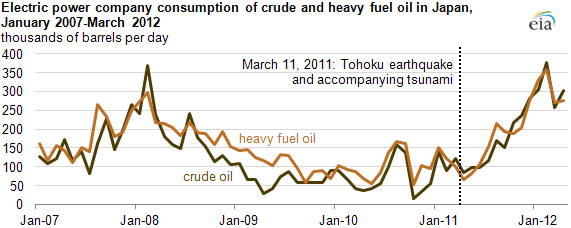
Japan’s use of Gas & Oil for power generation has doubled in 1 year. #rsrh

Japan’s use of thermal generation is up since March 2011 due to nuclear plant outages

Japan’s use of thermal generation—the combined amount of electricity generated from natural gas, oil, and coal-fired plants—was up 40% for January-April 2012, compared to the same period in 2011 due to the Tohoku earthquake and related tsunami that led to the accident at Tokyo Electric Power Company’s (TEPCO) Fukushima Daiichi nuclear power plant and subsequent outages at other plants (see chart above). …

Nuclear power generation accounted for about 30% of Japan’s total generation, on average, between 1987 and 2011. As a result of the nuclear outages, thermal generation of electricity rose to 90% of Japan’s total electricity output during the first four months of 2012, compared to an average of 64% for the same period in 2011.

Japan’s electric power utilities are consuming more liquefied natural gas (LNG) and petroleum to make up for the shortfall in nuclear output. Total post-Fukushima fossil fuel consumption peaked at about 500 trillion British thermal units in January 2012 … . Coal consumption, on the other hand, is relatively unchanged since before the accident.

(From the Energy Information Administration – eia.gov)

{Editor’s note: Both crude oil and fuel oil usage have increased from 100,000 to 300,000 barrels per day in the last year. That’s enough to be noticed in the world markets. Using oil for electricity generation is like swatting flies with a baseball bat. But since Japan has no native source of natural gas, there are few alternatives. SM}

Posted in Uncategorized | Leave a comment

Study Reveals the Gulf of Mexico Permitting Mess

In a rational world, the Federal government would act as a motivated lease owner who was interested in promoting the safe and environmentally responsible development of his mineral resource, consistent with sound conservation practice. That’s why there’s a permit process in the first place.

Since Macondo, that’s backwards. Operating practices must conform to the permitting process that has, um, evolved in a purely political environment: practical considerations, economics and common sense be damned. And while the politicians proclaim a concern for production levels, product prices and jobs, their actions and policies tell another story.

A study (pdf link) of Gulf of Mexico activity released on Wednesday by the Gulf Economic Survival Team (GEST) indicates that much of the progress claimed by the Obama Administration  is illusory. The Administration is putting a lot of time and effort into buffing the statistics to make it appear as though things are going swimmingly. (Just like in kids’ sports, ownership of the official scorebook can be a significant advantage. It never hurts to keep one eye on the scorekeeper.)

The study was performed by Dr. Bernard L. Weinstein of SMU’s Cox School of Business.

[It details] the fallout from two years of difficulty implementing offshore regulations that were revamped after the Macondo blowout. The continuing regulatory issues have led to decreased federal revenue, fewer active rigs in the Gulf, and lower forecasts of future production from the Gulf of Mexico. …

According to the report, companies attempting to plan and execute enormously expensive, multi-year offshore energy projects are not receiving the transparency and predictably required to conduct business. When the market lacks confidence that the government will remove obstacles to energy production in the Gulf of Mexico and elsewhere, traders incorporate this risk into current thinking and future price structures. Today’s offshore regulatory regime has bred a high “U.S. regulatory risk premium” that is dampening production and causing a hidden surcharge on the price of oil and gasoline in the market.

Dr. Weinstein’s executive summary highlights the problems with permitting and transparency:

  • Federal revenues from Gulf activity dwindle: Lease sales that brought billions of dollars in bonus consideration as recently as 2008 returned only $36 million in 2011’s only lease sale. With production off (see below), royalty income is down.
  • GOM rig count increases are misleading: Notwithstanding “official” rig statistics, the number of rigs actually drilling wells has declined from 27 before Macondo to 18 as of May 1.
  • Deemed ‘submitted’ period expanded: Now the staff goes over a new plan with a fine tooth comb to verify that it is 100% complete before it is “deemed submitted” – a new step in the process that makes it appear that permits are still being handled expeditiously. Since Macondo, the total time required for an average plan approval has ballooned from 50 to 207 days.
  • Permit approval claims overblown: Many permits counted in the statistics were to restart operations suspended due to Macondo. Of 94 permits grant, only 32 were for actual new wells targeting hydrocarbons.
  • Just-in-time permitting breeds uncertainty: With 18 active deep-water rigs, the inventory of approved, “ready-to-go” permits should be at least 54. As of March 31, there were only 6 – leading companies to question where their rigs will be going next.

The study further confirms what has previously been reported in these pages: current levels of oil production (in blue) from the Gulf are running 30% below what was expected in the last pre-Macondo production forecast (in red):
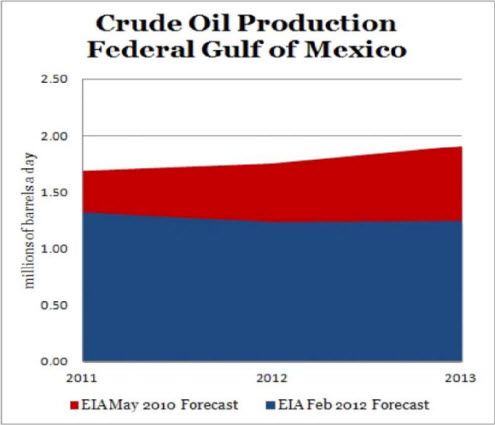
That shortfall is nearly 10% of domestic production. According to Dr. Weinstein, it affects the consumer’s price at the gasoline pump. He concludes:

The outlook for oil and gas production in the Gulf of Mexico remains murky. Companies making massive investments of capital and time require predictability and confidence that production goals can be met. If companies find it increasingly difficult to tell their own executives and board members when projects are going to be approved, this uncertainty will affect decisions about where to place future capital investment. Investors need reasonable predictability or they will simply look elsewhere for more inviting opportunities. If Gulf production is to reach levels that equal its true potential in the months, years, and decades to come, the regulatory sphere must deliver on its obligation to provide a predictable review and approval process.

President Obama is on target when calling for an “all-of-the-above” energy strategy, both to enhance domestic production—with all the attendant benefits of jobs and revenue—and to ensure America’s energy security. The Gulf of Mexico contains some of the world’s largest reservoirs of recoverable crude oil and natural gas. Bringing reasonable speed and transparency to the permitting process for deep water drilling is a critical component of a meaningful all-of-the-above domestic energy strategy. Absent such actions, American households and businesses will continue to pay a hidden “surcharge” on oil and gasoline that reflects the current regulatory risk premium.

Emphasis mine.

Cross-posted at RedState.com.

Posted in Energy, Government | Tagged , , | 1 Comment

Sittin’ on Top of the World

And now she’s gone, and I’m not worried
‘Cause I’m sittin’ on top of the world.

Posted in Uncategorized | Tagged | Leave a comment