The Big Energy Lie, Revisited

Your President has been telling you things that simply aren’t true. Things like “We can’t drill our way out of our energy problems.” Or “Oil and gas are the fuels of the past.” Or “The U.S. consumes 25% of the world’s oil, but controls only 2% of the world’s reserves.”

Well, that last one may be technically true, but it is used to convey a falsehood. In a post called The Big Energy Lie (Dec. ’09), I attempted to explain the deception. In this post, I’ll attempt to show you graphically in terms that the lay person should understand.
Continue reading

Posted in Energy | Tagged , , , | 15 Comments

How Much Will It Cost to Repeal the ‘Oil Subsidies’?

This week, the Senate is set to consider the repeal of certain provisions of the tax code as they relate to the oil and gas industry. By styling these tax breaks as “subsidies”, the Administration and other opponents of the industry wrongly equate them with the benefits enjoyed by ethanol, wind and solar energy. But the tax credits for alternative energy production are true subsidies, essentially cash payments to producers of energy that cannot compete in the marketplace without help.

Randall Hoven at American Thinker gives a good breakdown the specifics of the tax breaks targeted by the Administration. I’ll not rehash those details, but will add three points worthy of emphasis: 1) the tax breaks are not as unique to oil and gas as has been advertized;  2) two of the tax breaks in question are “cost recovery” deductions against income, not handouts (try telling your company’s CFO that his depreciation charge is a government subsidy); and 3) the brunt of the tax increase will be felt by independent companies, not “Big Oil”, which lost most of the benefit of these categories of deductions years ago. Energy state Democrats like Rep. Dan Boren of OK, former Rep. Martin Frost of TX and LA Senator Mary Landrieu agree that Administration proposals would indiscriminately punish “small oil”, damaging American energy security in the process.

Some 9.2 million jobs depend on the domestic oil and gas business. Oil and gas activity also creates plenty of revenue for the public coffers. It’s altogether possible that these effective tax increases could be a net negative for government revenue. Shouldn’t someone ask  “Can we afford it?”

Continue reading

Posted in Energy | Tagged , , , , , | 4 Comments

Wasserman Schultz: ‘We’ve really concentrated’ on oil production

There was an undeniable uptick in U.S. oil production in 2009 and 2010.

But new DNC chair Rep. Debbie Wasserman Schultz (D-FL) tried to take credit for it:

Like I said, domestic oil production is at its highest point in recent years. So we’ve actually really concentrated on that.

Democrats patting themselves on the back for oil production increases?

Ba. Lo. Ney.

With all due respect. Continue reading

Posted in Energy | Tagged , , , , | 4 Comments

‘Why does my gas cost $4.00 per gallon?’

Everybody is asking that question these days. The average nationwide price for all grades this week is $3.96/gallon; Californians are paying on average $4.26, the highest in the nation.

Why does it cost so much, especially considering that the price was below $2.00/gallon just within the last couple of years?

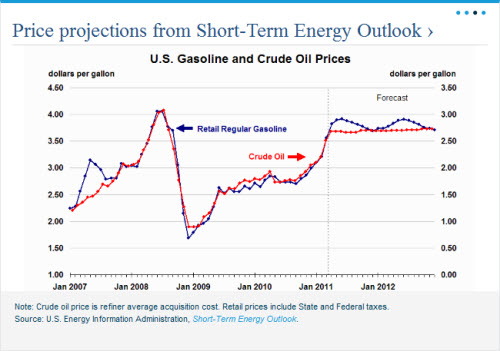
Nearly seventy percent of the price of a gallon of retail gasoline is the price of the crude oil it is refined from. Two graphs from the Energy Information Administration (EIA) make that point. The first shows the price of a gallon of gasoline (left axis) plotted against the price of a gallon of crude oil (right axis). The two move in virtual lock-step with each other; if you know the crude oil price per gallon, add $1.00 and you’ll know the price of gasoline within a few cents. (At $105 per 42-gallon barrel, the per-gallon price is $2.50.)

Continue reading

Posted in Energy | Tagged , , , , , | 3 Comments

Apparently, Climate ‘Science’ Is Not A Two-Way Street

Tornadoes in Alabama and the South: Is Climate Change to Blame?

The bottom line: It’s plausible that the warming of our planet could affect the frequency and intensity of tornadoes, though there’s little solid evidence to back up the claim.

Then why are we discussing it?

When we experience record-setting cold winter temps, or relentless blizzards, warmers caution us: “Weather is not Climate!” followed immediately by the claim that AGW theory predicts extreme weather.

Never mind the fact that AGW ‘scientists’ were predicting the end of snowfalls back in 2000.

To the AGW community a hindcast and a forecast are the same thing.

Posted in Climate | Tagged , , | Leave a comment

Blast from the Past: ‘Remember $4.00 Gas? Just Wait.’ (Dec ’09)

From Vladimir’s diary, dated December 18, 2009:

Remember $4.00 per Gallon Gasoline? Just Wait.

Well, here we are, less than 18 months later.

A little context: Gasoline prices (national average, all grades) peaked over $4.00 per gallon for a couple of months in the summer of 2008.

Prices bottomed in December 2008 at $1.66. By December 2009, at the time of the writing of the linked diary (reproduced below), the price had rebounded to $2.60 per gallon. Since then, the price is up 50%, and Our President is acting both clueless as to the reason, and powerless as to the solution.

Not only were higher energy prices totally foreseeable, they were part of the plan all along. High energy prices were considered necessary to boost green energy. Not only does Mr. Obama not have a solution, he does not want a solution. Continue reading

Posted in Energy | Tagged , , , , | Leave a comment

EPA Ruling Kills Shell’s Plans to Drill Offshore Alaska

A ruling by the Environmental Appeals Board of the EPA has scuttled Shell Oil Company’s plan to drill its initial exploratory test in Alaska’s Chukchi Sea. This is at least the second time drilling has been deferred or delayed due to environmental concerns. But this time, the reason proffered by EPA seems to be “Because we can.”

The EPA’s appeals board ruled that Shell had not taken into consideration emissions from an ice-breaking vessel when calculating overall greenhouse gas emissions from the project. Environmental groups were thrilled by the ruling.

We have handed radical environmentalists veto power over domestic development. It matters little whether the pretext is ship exhaust 70 miles from the nearest human, “burning water” or a 3-inch lizard in West Texas, environmental extremists are hell-bent on shutting down any and all development of conventional fuels in the United States. In EPA, they have all the tools they need. Continue reading

Posted in Energy | Tagged , , , , | 1 Comment

For My Good Buddy, Tim

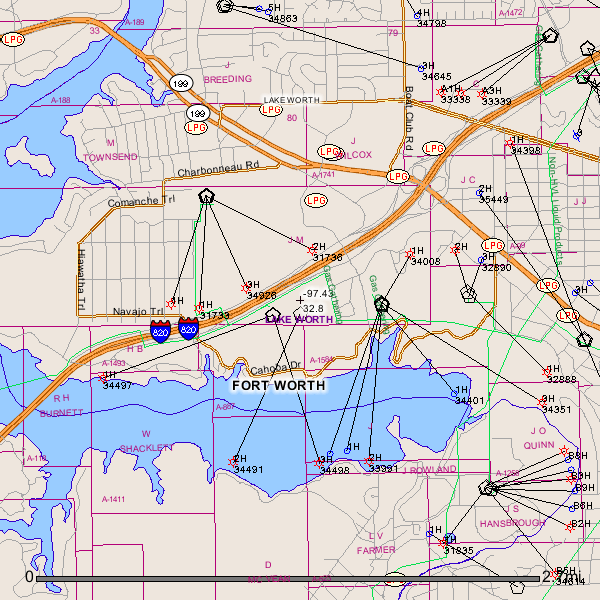
Oil and Gas Wells in the Vicinity of Lake Worth, TX

Tim –

Re: your youtube video: http://youtu.be/tUOuw-4NFsc

I thought at first you were posting the “burning water” scene from Gasland. (Now *that’s* propaganda.)

But instead it’s your attempt to debunk an educational video from the American Petroleum Institute which shows industry’s ability to drill multiple wells from a single site.

Somehow, you interpreted it to mean “No more wells!” How you concluded that is anybody’s guess — nowhere did API claim that wells are no longer needed, just that with modern techniques, it is possible to drill multiple wells with minimal impact on, for example, freeways, lakes and residential subdivisions.

In fact, the map above was paid for with your tax dollars. It is from the Railroad Commission of Texas, the statewide oil and gas regulatory body. The are may look familiar to you, as it is the same area that you used in your video, where you unmasked API’s “lie”, apparently because there are 3 wells near your neighborhood.

Now look at the map, in particular your three wells. The pentagon-shaped symbols on the map correspond with the wells’ surface locations. The black lines emanating from the symbols represent a well path. The “bottomhole location” of each well is represented by a symbol which tells you something about that well. Most of these are gas wells in the Newark, East (Barnett Shale) Field, which spans several counties in and around Ft. Worth.

Your three locations support 2, 3 and 4 producing wells, respectively — a total of 9 — which was precisely the point of the API video: new technology, smaller “footprints”. And they were talking about places like Ft. Worth, Tim. Directional and horizontal drilling technology has enabled development of gas in and near your freeways, lakes and residential subdivision.

The Newark, East (Barnett Shale) Field is the #2 gas producer in the nation (only recently displaced as #1). As a result, lots of homeowners in suburban Ft. Worth receive nice monthly royalty checks because of their ownership of the minerals under their property.

Now, if you’re not receiving one of those monthly checks, it may be that you haven’t been drilled yet, or your land has not been placed in a producing unit. Or the seller may have retained the minerals when you purchased your house. Are you pissed because you’re not receiving a check? (And if you are receiving a check, I hope you’re not cashing it; otherwise you’re a huge hypocrite.)

Posted in Energy | 2 Comments

Obama Appoints ‘Oil and Gas Price Fraud Working Group’. It’s About Time!

Because I’m sick and tired of giving away gas for almost nothing!

As the graph below shows, the price of gas is languishing just above $4.00 per thousand cubic feet.

I’m selling gas at 2/3 the price it was back in 2005, and about a third of its peak price in 2008! Somebody must be cheating me out of my gas, and it’s about time Obama looked into it!

Huh? What’s that? You don’t think that’s the kind of “gas” he was talking about? That can’t possibly be. We all refer to gasoline as “gas” informally, but the use of the phrase “oil and gas” (as in “the oil and gas industry”, or in the name of the President’s recently-announced “Oil and Gas Price Fraud Working Group”) always connotes oil and natural gas. At least among knowledgeable people. Continue reading

Posted in Energy | Tagged , , , , , , | 1 Comment

BP’s Macondo Disaster, One Year Later

On April 20, 2010, an explosion and fire on the Transocean drilling rig Deepwater Horizon caused the deaths of 11 rig workers. The subsequent blowout flowed uncontrolled to the Gulf of Mexico, ultimately spilling an estimated 5 million barrels of crude oil over the next 100 days. The regulatory aftermath continues to this day.

“Vladimir” wrote dozens of diaries at RedState on the engineering, environmental, economic and political aspects of the spill and its aftermath. The first was “Please Pray for the Missing Eleven” published a year ago tomorrow. It was soon followed by “Why Was BP Drilling in 5,000 ft of Water?” which looked at the disconnect between our voracious appetite for hydrocarbons, and our relative lack of concern as to its source (as long as it’s available and affordable). Vlad’s diary “The Pro-Environment Anti-Environmentalist” recapped several earlier diaries, highlighting the contrast between the predictions of scientific doomsayers and journalistic hysterics on one hand, versus a solitary blogger with a smattering of knowledge of earth science on the other.

The anniversary is an opportunity to look back on what we’ve learned. For if a failure is to be anything other than pure tragedy, we must learn the lessons it conveys. Continue reading

Posted in Energy | Tagged , , , , | 2 Comments