Rx for Job Growth, Federal Revenue and Energy Security: Drill, Obama, Drill!

The Gulf Economic Survival Team (GEST) is a consortium of large and small companies that have been negatively affected by the Department of the Interior’s bureaucratic overreaction to the BP oil spill. Earlier this year, GEST commissioned a study by IHS-CERA, a leading energy-oriented think tank, to determine what impact could be expected if BOEMRE (the Bureau of Ocean Energy Management, Regulation and Enforcement, DOI’s offshore regulatory arm) were to return to the pace of plan review and permit approval that was considered routine before the BP spill.

In anticipation of an Obama policy pronouncement on the economy and renewed stimuli on Thursday night, GEST sent a letter to President Obama, pointing out that a return to previous policy would quickly put 230,000 workers to work. Not only would it not cost the government a dime of stimulus money, it would generate revenue for the Treasury by the $billions. It would also enhance domestic fuel production, reduce imports and improve our balance of trade.

Swift action to reduce the growing backlog of plans and increase the pace of plan and permit approvals to explore for oil and natural gas resources in the deepwater Gulf of Mexico would increase employment opportunities in almost every state, boost tax and royalty revenues for governments, and help stabilize US energy security. And these benefits could materialize rapidly. Early alignment between the capacity to properly regulate oil and natural gas activities and the pace and scale of investment opportunities would capture the largest possible share of the activity gap, which in 2012 results in

  • 230,000 American jobs
  • more than $44 billion of US gross domestic product (GDP)
  • nearly $12 billion in tax and royalty revenues to state and federal treasuries
  • US oil production of more than 400,000 barrels of oil per day (bd) (equivalent to approximately 150 million barrels in the full year)
  • reducing the amount that the United States spends on imported oil by around $15 billion

The employment effects would not be limited to the Gulf states. One third of those jobs would be generated outside the Gulf region in such states as California, Florida, Illinois, Georgia, and Pennsylvania.

[Emphasis added. – Ed.]
Continue reading

Posted in Economy, Energy | Tagged , , , , , | Leave a comment

Is Irene a Harbinger, or Just a Cigar?

Is Hurricane Irene a “harbinger of human-induced Climate Change” as a New York Times headline suggests, or just a seasonal tropical cyclone? Hurricane season, after all, peaks in mid-September.

Seeing Irene as Harbinger of a Change in Climate
By JUSTIN GILLIS, The New York Times August 27, 2011

The scale of Hurricane Irene, which could cause more extensive damage along the Eastern Seaboard than any storm in decades, is reviving an old question: are hurricanes getting worse because of human-induced climate change?

The short answer from scientists is that they are still trying to figure it out. But many of them do believe that hurricanes will get more intense as the planet warms, and they see large hurricanes like Irene as a harbinger.

While the number of the most intense storms has clearly been rising since the 1970s, researchers have come to differing conclusions about whether that increase can be attributed to human activities.

Junk science, junk journalism, or both?

  • Presumes facts not in evidence: “are hurricanes getting worse because of human-induced climate change?” and “… the number of the most intense storms has clearly been rising since the 1970s… “
  • Falls back on the old journalist’s crutch when promoting a junk science thesis: “Some scientists say…”

By contrast, here is a post based in fact and scientific observation, which dismantles the basic assumption of the Times’ piece. Continue reading

Posted in Climate | Tagged , , , , , | Leave a comment

Edwin Edwards for Governor?

Fans of former Louisiana Governor Edwin Edwards have created a Facebook page called “Ask Obama to Pardon Edwin Edwards”. As an convicted felon, the Silver Zipper is precluded from running for a fifth term as governor. Barack Obama could change all that.

According to Edwin, you see, Bobby Jindal has things so messed up in Louisiana that the Democrats are having trouble finding anyone to take on the challenge.

Edwards said that in the relatively short time that he’s been out of prison on racketeering charges he has found “there are a lot of people who want Jindal to have opposition and a lot of people who want me to be governor. You put those two factors together and you have a lot of talk about the possibility of my running. It’s both flattering and understandable, given the status of Louisiana politics today.”

Edwards said he was approached by Democratic Party leaders to encourage possible challengers to Jindal’s re-election but “for a multitude of different reasons, nobody seems interested in tackling the job and I’m not sure that I blame them.”

Heh. Continue reading

Posted in Louisiana, Politics | Tagged , , , , , | Leave a comment

Drilling in New Jersey? No Fracking Way!

New Jersey Governor Chris Christie issued a conditional veto on a measure that would have imposed a permanent ban on hydraulic fracturing — a/k/a “fracking” — in the Garden State. Instead, Christie has suggested a year-long moratorium on the practice.

The debate over fracking in New Jersey is mostly symbolic. New Jersey has exactly zero oil and gas wells. It is, however, the nation’s #7 natural gas consuming state (5% 0f total consumption), ranking ahead of Texas. Since 90% of gas wells are completed with a frac treatment, an anti-fracking New Jersey is a little like an obstetrician who promotes total celibacy among his patients. Continue reading

Posted in Energy | Tagged , , , , , , | Leave a comment

Exxon’s Offshore Lawsuit: The Rest of the Story

Last week, ExxonMobil filed a lawsuit against the Department of the Interior in the Western District of Louisiana. The lawsuit alleges that DOI, through the Minerals Management Service (MMS), acted improperly in cancelling three leases owned by ExxonMobil and Statoil, its 50% partner. The leases lie in 7,000 feet of water, some 200 miles off the Louisiana coast. The story of was covered by the Wall Street Journal, the Houston Chronicle and numerous blogs.

But the outlets I’ve read did not delve into what is both the most interesting and the most troubling aspect of the controversy: the Government’s motivation. In sum:

[44] As ExxonMobil demonstrated in the administrative proceedings below, Interior’s economic incentive to cancel the Original Julia Leases is clear. Cancelation [sic] of the Original Julia leases would enable Interior to grant new leases on Walker Ridge Blocks 584, 627, and 628. Because producible wells have been drilled on Walker Ridge Blocks 584 and 627, the lease bonuses to be paid to Interior for new leases of those blocks would be very high. Moreover, new leases of Walker Ridge Blocks 584, 627, and 628 would not be subject to the mandatory royalty relief that applies to the Original Julia Leases under Section 304 of the RRA. Accordingly, by enabling Interior to grant new leases on blocks with proven reserves, cancelation of the Original Julia Leases would give Interior the opportunity to collect millions of dollars in bonuses and royalties that it otherwise would not be entitled to collect if the Original Julia Leases are not canceled.
[Emphasis mine.]

This Administration would make Hugo Chavez proud. Continue reading

Posted in Energy, Politics | Tagged , , , , , , , , | Leave a comment

Two Words for Michele Bachmann and the $2 per Gallon Gasoline Pledge

Here they are: Natural Gas.

I’m as bullish on domestic oil as the next guy, but I’m also a realist. I don’t see any way to solve a problem with the scope and breadth of our nation’s dependence on foreign crude oil during a president’s term of office. It is simply not an overnight solution.

Yes, the national average gasoline price was below $2.00 per gallon when President Obama took office. It stayed there for all of four months. That was a time when we were all reeling from the economy’s precipitous decline, coupled with a historic collapse in the crude oil price from $140 to $36 per barrel.

We can’t find and produce oil and bring it to market for $36 per barrel. Not from the sources you name – the eastern Gulf, ANWR. It will take many years to bring on new oil from those sources anyway. The only way I see prices getting back to $2 per gallon is with demand destruction — a collapsing economy. Personally, I’d prefer not to see the Dow below 7,000 again in my lifetime.

But there is a solution, and one that could make you look like a genius: natural gas. Good American natural gas, right here, today, is less than $2.00 on a gasoline-equivalent basis.

We’re blessed with an abundant, domestic resource base of natural gas. It is a clean transportation fuel that would directly put a dent in oil imports. A strategic focus on natural gas would create jobs almost immediately. The flow of royalties, severance taxes, sales and income taxes would benefit private and public coffers alike.

A strategic commitment to natural gas as a transportation fuel is the one thing that might get us $2.00 per gallon gasoline (equivalent).

Cross-posted at RedState.com.

Posted in Energy, Politics | Tagged , , , | 3 Comments

If Global Warming Doesn’t Kill Us, ET Will

Jon Huntsman tweeted yesterday:

To be clear. I believe in evolution and trust scientists on global warming. Call me crazy.

Um. These scientists you trust, some of them at least, are accused of data manipulation and standing the peer-review process on its head. Call me crazy, but I don’t trust them.

In related news, The Guardian brings us:

Aliens may destroy humanity to protect other civilisations, say scientists

Continue reading

Posted in Environment | 1 Comment

Drilling Rigs in Pennsylvania! Hide the Womenfolk!

Democratic State Rep. Michael Sturla is apparently not the sharpest knife in the drawer. Speaking of the impact of the Marcellus Shale drilling boom on Pennsylvania, Sturla said:

“Also, aside from building roads so their trucks can get to drill sites and doing a little stream work to mitigate damage from their road building, exactly what are all those things the drillers are doing for the local communities? Patronizing the bars at night? Driving up the cost of rental housing? Spreading sexually transmitted disease amongst the womenfolk? …”

Even though Sturla’s home district in Lancaster County lies outside the Marcellus Shale trend, it would be hard not to be aware of the impact of gas drilling on the Keystone State’s economy. As documented in a study by Penn State University, the estimated benefits include:

Continue reading

Posted in Economy, Energy | Tagged , , | Leave a comment

Keystone XL Pipeline: Bureaucratic Hacky-Sack

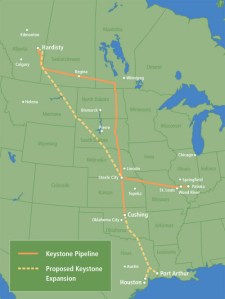
Larger image below the fold.

The Obama Administration continues to play bureaucratic hacky-sack with what could be a key element of our nation’s secure energy future: the Keystone XL pipeline project. The new line would increase the export capacity of the Keystone Pipeline (placed in service 2008) by 700,000 barrels of Canadian oil-sands oil per day. The expansion would also facilitate the domestic movement of crude from the key storage hub at Cushing, OK to the large refinery complexes on the Gulf Coast.

Keystone owner TransCanada is willing to take on this massive construction project on its own dime (or rather, its own $7 billion). It needs permission from the U.S. EPA and the State Department, which has jurisdiction due to the international scope of the project. The pipeline should have been under construction by now, were it not for Administration foot-dragging.

Opponents of the Keystone XL project might think they’re saving the environment by blocking the line. Not so.

  • Without the line, Canadians will sell the oil to the Chinese, who will export the oil in tankers.
  • Without the line, American imports will necessarily increase. More tankers.
  • Unlike tanker spills, pipeline spills are of limited volume and limited environmental impact. Pipelines are the most efficient and cleanest way to move volumes of oil.

Continue reading

Posted in Energy | Tagged , , , , , | 10 Comments

It’s Not Easy Going Green, Part IV

Remember jatropha? In 2007, Goldman Sachs called it one of the best candidates for future biofuels. Time Magazine touted its promise in an article from January, 2009:

Renewable energy, it turns out, does grow on trees. The fruit pods plucked from jatropha trees have seeds that produce clean-burning diesel fuel. But unlike corn and other biofuel sources, the jatropha doesn’t have to compete with food crops for arable land. Even in the worst of soils, it grows like weeds. Sound too good to be true? …

If President Barack Obama’s green-energy rhetoric is on the level, this should be the year the U.S. gets clued in to what much of the rest of the world is already betting: that jatropha, like other nonfood sources such as algae, will revive a biofuels movement battered of late by charges that it diverts too many crops from too many mouths. India has set aside 100 million acres for jatropha and expects the oil to account for 20% of its diesel consumption by 2011. Australia, China, Brazil and Kenya have also embraced it. In December, a Boeing 747 was successfully test-flown by Air New Zealand using a 50-50 blend of jatropha and aviation fuel.

A Boeing 747? Cool. But it’s 2011; so how has jatropha worked out?
Continue reading

Posted in Energy, Environment | Tagged , , , | Leave a comment