Maley’s Energy Blog Search
-
Join 58 other subscribers
-
Recent Posts
Blogroll
Categories
Meta
Archives
- December 2025
- August 2025
- November 2022
- April 2021
- November 2020
- October 2020
- September 2020
- August 2020
- July 2020
- June 2020
- April 2020
- February 2020
- January 2020
- September 2019
- August 2019
- June 2019
- April 2019
- March 2019
- February 2019
- January 2019
- October 2018
- September 2018
- August 2018
- May 2018
- February 2018
- September 2017
- March 2017
- December 2016
- November 2016
- October 2016
- September 2016
- August 2016
- July 2016
- June 2016
- May 2016
- February 2016
- January 2016
- December 2015
- November 2015
- August 2015
- March 2015
- February 2015
- January 2015
- September 2014
- August 2014
- July 2014
- June 2014
- May 2014
- April 2014
- March 2014
- February 2014
- November 2013
- October 2013
- September 2013
- August 2013
- July 2013
- June 2013
- May 2013
- April 2013
- March 2013
- February 2013
- January 2013
- December 2012
- November 2012
- October 2012
- September 2012
- August 2012
- July 2012
- June 2012
- May 2012
- April 2012
- March 2012
- February 2012
- January 2012
- December 2011
- November 2011
- October 2011
- September 2011
- August 2011
- July 2011
- June 2011
- May 2011
- April 2011
- March 2011
- February 2011
- January 2011
- December 2010
- November 2010
- October 2010
- September 2010
- August 2010
- July 2010
- June 2010
- May 2010
- April 2010
- March 2010
- February 2010
- January 2010
R.I.P. Karen Black
Posted in Uncategorized
Leave a comment
#RSG13: Least popular backdrop for candidate photo ops. #rsrh #RINO
Posted in Uncategorized
Leave a comment
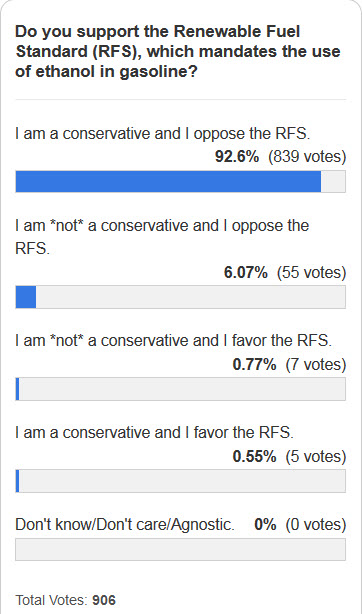
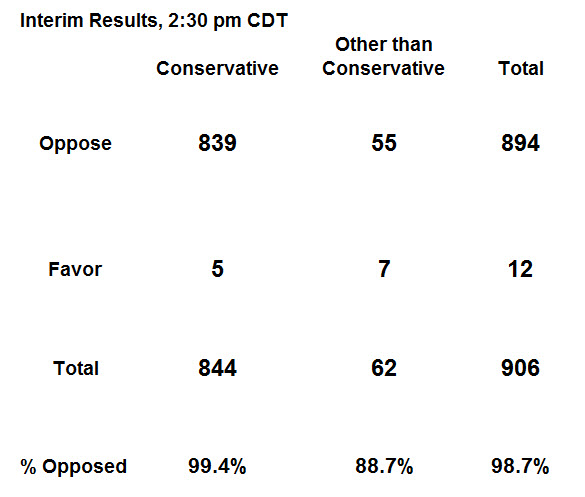
Poll: Do you support the Renewable Fuel Standard? #rsrh
In order to encourage the use for ethanol as a replacement for fossil fuels, Congress passed the Renewable Fuel Standard (RFS) in 2005. The RFS mandates annual volumes of ethanol that are required to be blended into the nation’s gasoline supply. Those volumes increase annually through 2022.
You are invited to participate in this admittedly unscientific poll.
Posted in Energy, Environment
7 Comments
My Pet Peeve
Well, OK, one of my pet peeves.

This is a common sight in coffee shops. In this case it’s at my favorite local coffee shop, Johnston Street Java in Lafayette.
Why the owners/managers would tolerate such an obvious trip hazard is beyond me. Someone is going to trip over it and end up owning a coffee shop.
Posted in Uncategorized
Leave a comment
TX RRC Commissioner to EPA: One-size-fits-all regulations inappropriate. #rsrh #dontmesswithtexas #oilandgas
http://www.oginfo.com/texas_oil_gas_info/texas_better_equipped_than_epa
TX RRC’S CRADDICK TELLS WASHINGTON – TEXAS BETTER EQUIPPED THAN THE EPA
Texas Railroad Commissioner Christi Craddick, in testimony July 25th before the U.S. House Committee on Natural Resources’ subcommittee on Energy and Mineral Resources, said that efforts to impose cumbersome federal regulations on hydraulic fracturing in Texas by the U.S. Environmental Protection Agency (EPA) would be detrimental to Texas energy production and job creation. “Texas has successfully regulated oil and gas production for almost 100 years and knows better than the federal government how to both serve and protect the unique interests of our state,” Craddick said in her testimony in support of HR 2728 (Flores), the Protecting States’ Rights to Promote American Energy Security Act. “A one size fits all model does not work, as different rules for different states are most effective in adhering to a wide variety in geography, geology, and environments,” Craddick said. “Unlike the federal government, Texas energy regulation is based on rules in contrast to permit- or study- driven regulation. Free market principles guided by rules in Texas allow companies to drill, so long as the rules are followed,” Craddick said. “The Railroad Commission has in place a successful and comprehensive regulatory framework taking industry best practices into account to ensure that all oil and gas activities occur while our natural resources—Texas air, land and water—remain safe. “Texas produces almost one third of total U.S. crude oil today. Last year, there were a total of 427,761 oil and gas jobs in Texas,” Craddick said. “As our nation nears energy independence, it is vital now more so than ever that energy producing states are not over-burdened by federal regulations that stifle production growth. While energy resources are abundant throughout the world, Texas’ supply is significant. Our state’s regulatory policies have enabled Texas to become one of the world’s greatest energy producers, leading the U.S. toward energy independence. Overreaching federal oversight would shut Texas’ energy industry down.”
Could not agree more. The geologic settings of all the different producing basins – from Texas to North Dakota to Pennsylvania to California to Alaska – are vastly different. A comprehensive set of one-size-fits-all regs and a blanket regulatory mentality protect nothing.
Posted in Uncategorized
Leave a comment
Vladimir’s Guide to New Orleans
I asked my good friend and erstwhile RedState diarist Vladimir to put together a quick list of recommendations and handy links for Gathering visitors.
Vladimir and I are looking forward to seeing you at the RedState Gathering 2013. We hope you have fun and enjoy the sights, sounds and tastes of this wonderful, historic city.
Getting Around
Travel to/from Louis Armstrong International Airport will either be by cab or by airport shuttle.
A cab ride costs $33.00 from the airport to the Central Business District (CBD) for one person and $14.00 (per passenger) for three or more passengers. Pick-up is on the lower level, outside the baggage claim area. There may be an additional charge for extra baggage.
Shuttles: Cost $20 but make multiple stops at various hotels.
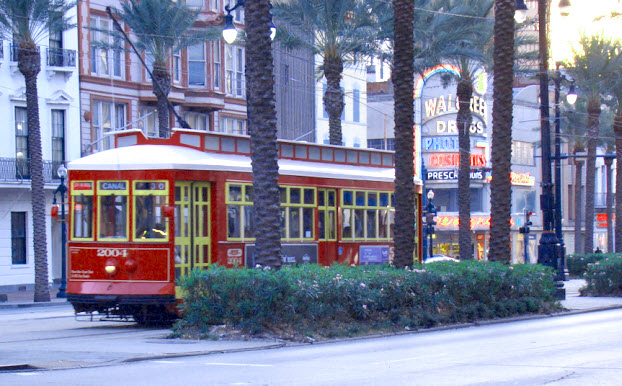
In the city, there are several streetcar lines and city buses run by the Regional Transit Authority. Buses and streetcars are $1.25 one way.
The historic streetcar line runs up St. Charles Avenue. Due to maintenance, I believe it is only running as far as Jefferson Avenue. It’s still worth the ride.
The Canal lines run to the Cemeteries at City Park Ave. Spurs connect down Loyola Ave to the train station and out Carrollton Ave. to City Park.
There is a Riverfront streetcar that primarily runs tourists from the French Quarter to the Convention Center, near the Warehouse District.
General Tips
It’s New Orleans. It’s August. Remember what PJ O’Rourke said.
You’ll want to dress for New Orleans’ humid, subtropical climate. Daytime temps will be well into the 90’s and the humidity may match. 30% chance of afternoon showers every day, so pack an umbrella.
Too many tourists leave with Bourbon Street as their only impression of the city. New Orleans is much more than Bourbon Street, so much more than the French Quarter.
Some tourists treat the French Quarter like it’s Disneyworld. It’s not. It’s a vibrant urban neighborhood. Especially at night, and especially after midnight, it’s best to travel in groups. Or catch a cab.
There are places that are within walking distance of the Westin that are not safe for a casual stroll, even in the daytime. To put that another way, if you really need to see St. Louis Cemetery No. 1 and No. 2, arrange for a professional guided tour. Ask your hotel concierges to plan your tour or to recommend a route for your walk.
Oh, and if anyone stops you and says “I bet I know where you got dem shoes,” the only correct answer is “You got ’em on your feet.”
Eating (as opposed to “Dining”)
If you will indulge me, I’ll pass along a few personal favorites, all within six blocks or so from the Westin Hotel at Canal Place.
Go to Mother’s (Poydras at Tchoupitoulas) for outstanding po-boys and plate lunches. The Ferdi is tops — a roast beef and ham po-boy. They’ll ask you if you want it “dressed”, which at Mother’s means cabbage instead of lettuce and tomato. “Debris” is the pan scrapings and gravy from the roast beef pan. The street is pronounced “chop-i-TOO-las”, just like it looks. Expect long lines; also open for breakfast.
Acme Oyster House is one block off Canal, at Iberville near Bourbon. Fried seafood, shrimp, oyster & catfish po-boys.
Deanie’s is one more block up Iberville, at Dauphine. Go there if you crave a fried seafood platter, onion rings and cold beer.
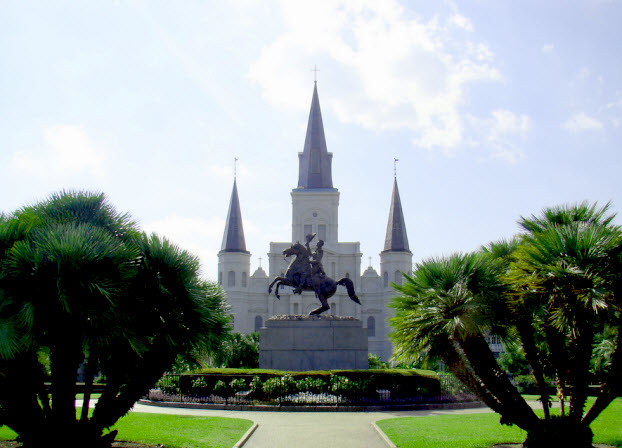
Cafe du Monde serves hot beignets and delicious cafe au lait 24 hours a day. Don’t wear black. Why visit New Orleans and go to Starbuck’s? Cafe du Monde is across Decatur from Jackson Square.
Ah! Also Central Grocery, the home of the fabulous muffaletta (pron. muff-a-LOTTA). 923 Decatur.
All the places above should accommodate a beer budget. If you’re looking for something more upscale, you could do worse than Mr. B’s (Royal at Iberville; get the gumbo ya-ya), the Palace Cafe (right on Canal) or the Bon Ton Cafe. If you go to the Bon Ton and don’t get the bread pudding with whiskey sauce for dessert, please don’t tell me; it will break my heart.
Beyond that, when it comes to restaurant recommendations, you can’t really go wrong with local food critic Tom Fitzmorris, who has been commenting on the local food scene since the 1970’s.
Then there are the Times-Picayune’s Guides to Restaurants, Bars and Live Music Clubs.
My bottom line advice in this department is that you will be rewarded by stepping out of your comfort zone and being adventurous. Chefs in New Orleans know how to handle seafood like nowhere else.
Sites and attractions
If you’re in town for a while you may want to consider:
The Garden District (accessible by St. Charles streetcar) Stretches of Prytania Street are particularly beautiful.
Audubon Zoo (Magazine bus, or Zoo Cruise on the river) [Update: Ooops! Sorry! Zoo cruise no longer in operation. – Ed.]
The Audubon Aquarium of the Americas and Insectarium (each 1 block from the Westin)
City Park (catch the “City Park/Museum” streetcar on the Canal line)
Magazine Street (accessible by bus)
The National World War II Museum
(Near Lee Circle in the Warehouse District) Highly recommended. Ranked #7 museum in the U.S. and #14 in the world by TripAdvisor.
R.I.P. JJ Cale, 74
He cut a wide path through 1970s rock ‘n’ roll, influencing some of the most famous musicians at the time with songs that were laid-back and mellow, yet imbued with a driving groove.
Clapton, Neil Young, Mark Knopfler and Bryan Ferry are among his many fans in the music world.
Neil Young has been quoted as considering Cale, along with Jimi Hendrix, to be the best electric guitar players.
Clapton said in his autobiography: “It is my humble opinion, he is one of the most important artists in the history of rock, quietly representing the greatest asset his country has ever had.”
Cale played with Leon Russell and other local musicians in Tulsa clubs in the 1950s and 1960s and also performed with the Grand Ole Opry touring company before achieving success with his debut “Naturally” album in 1972, which featured “Call Me the Breeze” and “Crazy Mama,” a top 40 hit.
Posted in Uncategorized
Leave a comment
R.I.P. George Mitchell, Father of the Shale Boom
George Mitchell, a son of a goatherd and a brilliant petroleum engineer and entrepreneur, died on Friday in Galveston at the age of 94.
Mr. Mitchell’s role in championing new drilling and production techniques like hydraulic fracturing, or “fracking,” is credited with creating an unexpected natural gas boom in the United States. In a letter to President Obama last year, Daniel Yergin, the energy scholar and author, proposed that Mr. Mitchell be awarded the Presidential Medal of Freedom.
“It is because of him that we can talk seriously about ‘energy independence,’ ” he said. (Mr. Mitchell did not receive the award.) Continue reading
Remember all the Green Jobs in our New Green Economy?
In the first four years of the Obama Administration, the Department of Labor spent $595 million training workers for the New Green Economy that President Obama promised. A recent Washington Post article (“Why it’s hard for the government to create green jobs“, July 21, 2013) says:
Four years later, it’s still not clear what all the cash for green jobs achieved–and a Government Accountability Office report issued last week illustrates the difficulty of trying to foster an emerging industry by pumping money into it.
No kidding. It’s not clear because the GAO report assiduously avoids an analysis of how many jobs were created, how many workers were trained and how effectively Labor spent taxpayer dollars.
One thing the GAO does have is a rather — *ahem!* — liberal interpretation of what constitutes a green job. Continue reading
Posted in Uncategorized
Leave a comment