The Bayou Corne Sinkhole, Part I: Ridiculing the Press

Scientifically illiterate and agenda-driven journalists can ruin what is actually a valid story. Today’s example is the coverage of the Bayou Corne sinkhole, an ongoing environmental situation of considerable concern at the Napoleonville Salt Dome in Assumption Parish, Louisiana. About 350 residents of the quiet community of Bayou Corne have been evacuated from their homes since the sinkhole’s sudden formation nearly a year ago.

Local coverage of the sinkhole has been somewhat perfunctory, and national stories almost nonexistent. The sinkhole has not claimed any lives collapsed any structures. The only casualties so far have been a few cypress trees. “If it bleeds, it leads” seems to explain the sinkhole’s low profile in the press, despite the notable presence of Erin Brokovitch, every plaintiff’s favorite paralegal.

But this week a new video caught the media’s (and the public’s) attention — over four million views and counting. The video, hosted on the Assumption Parish Police Jury youtube account, shows a stand of cypress trees (looks to me like 6 to 8, not 25) being suddenly sucked into the sinkhole, as the ground underneath them fails and sloughs off into the deep. Writer Elizabeth Barber contributes this description for the Christian Science Monitor:

The sinkhole first bubbled and trembled last June, and then about two months later caved in, swallowing about 24 acres of land. Ever since, the giant swamp thing has occasionally sighed and heaved, pulling down more brush and trees and dirt. The latest video, though, in which 25 trees bid their adieu to sunlight, is the first footage of its machinations.

RECOMMENDED: Are you scientifically literate? Take our quiz

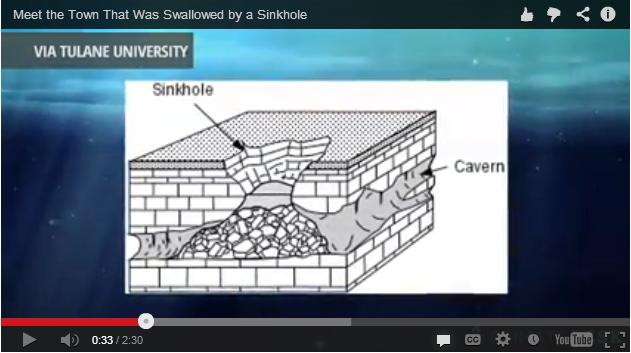
Sinkholes form when underground acidic water dissolves limestone until a cave is formed. The acid keeps eating away at the rock until the weight of the overlying landscape collapses the cave roof. On the surface, all looks well and calm until that cataclysmic point of no return is reached. Then the ground plummets downward, like a monster plunging into the foreground and breaking the dramatic silence of a horror film.

[Note: Emphasis added. Irony and turgid prose in original. – Ed.]

Actually, another video from over a month ago is less dramatic but perhaps more troubling. Water is not supposed to move like this in quiet Louisiana lakes and bayous:

That yellow boom is in place to contain crude oil that occasionally bubbles up from below.

A common mistake that journalists make is to equate the Bayou Corne sinkhole with other sinkholes that make the news, like the recent one in Florida that catastrophically collapsed part of a resort building. That’s the key scientific mistake Ms. Barber makes in the passage quoted above, and the misrepresentation that Mother Jones’ Tim Murphy makes in using a graphic depiction of the same process in his video:
karst

The Bayou Corne sinkhole has nothing at all to do with limestone and acidic ground water. More on that in Part II.

The title of Murphy’s article (“Meet the Town That’s Being Swallowed by a Sinkhole“) pretty much lays out the narrative template he chooses to follow, facts and science be damned.
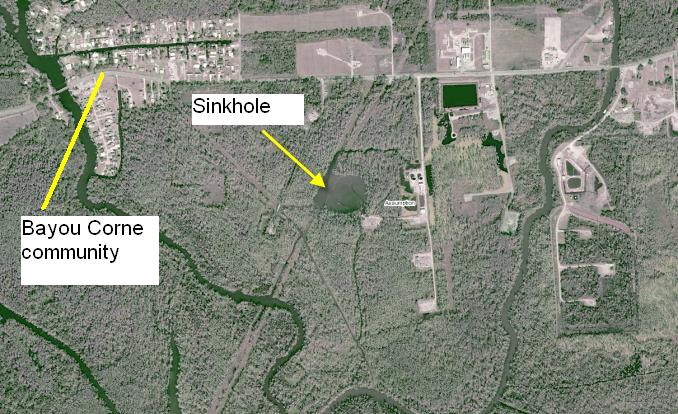
Bayou Corne 2012

That’s a 2012 image; as we shall see in Part II, the sinkhole has grown since then, but still does not threaten to “swallow” the town.

Murphy does make one assertion I agreed with at first reading:

Bayou Corne is the biggest ongoing industrial disaster in the United States you haven’t heard of.

But then I thought of the Hanford Site in Washington State, which will have an ultimate cleanup cost several orders of magnitude larger than Bayou Corne. A key difference: Hanford is Uncle Sam’s doing, not private industry, not “miners”, not “frackers”.

Murphy continues:

In addition to creating a massive sinkhole, [Bayou Corne] has unearthed an uncomfortable truth: Modern mining and drilling techniques are disturbing the geological order in ways that scientists still don’t fully understand. Humans have been extracting natural resources from the earth since the dawn of mankind, but never before at the rate and magnitude of today’s petrochemical industry. And the side effects are becoming clear. It’s not just sinkholes and town-clearing natural gas leaks: Recently, the drilling process known as fracking has been linked to an increased risk of earthquakes. [Which at best reflects gross ignorance, and at worst an outright lie. – Ed.]

“When you keep drilling over and over and over again, whether it’s into bedrock or into salt caverns, at some point you have fractured the integrity of this underground structure enough that something is in danger of collapsing,” observes ecologist and author Sandra Steingraber, whose work has focused on fracking and injection wells. “It’s an inherently dangerous situation.”

The problem at Bayou Corne was created by a salt cavern that was created, not “drilled into”, in 1982 using an inadequate understanding of the subsurface structure of the Napoleonville Dome. Today’s technology has improved. Steingraber here offers zero science, just fear of the unknown. Her assertion is akin to suggesting that a patient could suffer a collapsed lung as a result of a flu shot.

As a resident of Louisiana, I started investigating the sinkhole situation to see if it is under control and that state regulators and Texas Brine are taking adequate steps to protect the environment. The news stories above fail to address the science, the response and the future outlook for the sinkhole; again, I hope to do that in Part II.

For the 350 residents of Bayou Corne, I can only imagine the frustration and the stress that goes along with their year-long ordeal. My heart goes out to them, and my prayer is for a quick resolution so that they can return to their homes and resume their lives.

To be continued . . .
Cross-posted.

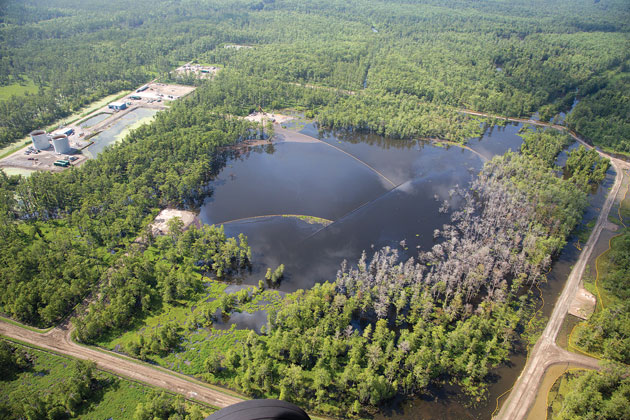
Aerial view of the sinkhole in 2013. (Credit:Jeffrey Dubinsky for Leanweb.org/LMRK.org)

Aerial view of the sinkhole in 2013. (Credit:Jeffrey Dubinsky for Leanweb.org/LMRK.org)

Posted in Environment, Louisiana | Tagged , | 2 Comments

Cheap Energy and the Third World. #ethics #wuwt #rsrh

http://wattsupwiththat.com/2013/08/21/double-the-burn-rate-scotty/

By Willis Eschenbach

“[T]he world’s poor people are starving and dying for lack of cheap energy today. Driving the price of energy up and denying loans for coal-fired power plants is depriving the poor of cheap energy today, on the basis that it may help their grandchildren in fifty years. That is criminal madness. The result of any policy that increases energy prices is more pain and suffering. Rich people living in industrialized nations should be ashamed of proposing such an inhumane way to fight the dangers of CO2, regardless of whether those dangers are imaginary or real.”

Posted in Uncategorized | Leave a comment

Al Gore Channels Nigel Tufnel

"I'm serial." (Recyclebank photo, slightly edited by @VladimirRS.)

“I’m serial.” (Recyclebank photo, slightly edited by @VladimirRS.)

In a “lightly edited”* interview transcript with the Washington Post‘s Ezra Klein, Former Vice President and Nobel** Laureate Al Gore puts climate deniers on the same moral plane as supporters of slavery and apartheid. (Clear logical connection there, Mr. Vice-President.) Then Al disgorges this chestnut of wisdom:

Would there be hurricanes and floods and droughts without man-made global warming? Of course. But they’re stronger now. The extreme events are more extreme. The hurricane scale used to be 1-5 and now they’re adding a 6.

Al is referring to the Saffir-Simpson Hurricane Wind Scale which rates hurricane wind destructive potential. Category 5, sustained winds greater than 157 mph, signifies total, catastrophic destruction. According to Wikipedia,

After the series of powerful storm systems of the 2005 Atlantic hurricane season, a few newspaper columnists and scientists brought up the suggestion of introducing Category 6, and they have suggested pegging Category 6 to storms with winds greater than 174 or 180 mph … Only a few storms of this category have been recorded.

According to Robert Simpson [one of the meterorologists responsible for the scale], there are no reasons for a Category 6 on the Saffir-Simpson Scale because it is designed to measure the potential damage of a hurricane to manmade structures.

Al would see eye-to-eye with rock legend Nigel Tufnel of the immortal band Spïnal Tap:

"It goes to eleven, d'un'it?"

“It goes to eleven, d’un’it?”

* Maybe Ezra should consider editing a little more heavily next time. The thing is full of typos, like “Exxon-Mobile” and “The consequences [of AGW] are now hard to escape. Every night on the news, it’s like a nature hike through the book of revelations.”

** Nobel Peace Prize.

Cross-posted.

Posted in Uncategorized | Leave a comment

Science are hard.

Posted in Uncategorized | 1 Comment

Interior: Keystone XL Pipeline will impact “cultural soundscapes” and “high quality night skies”.

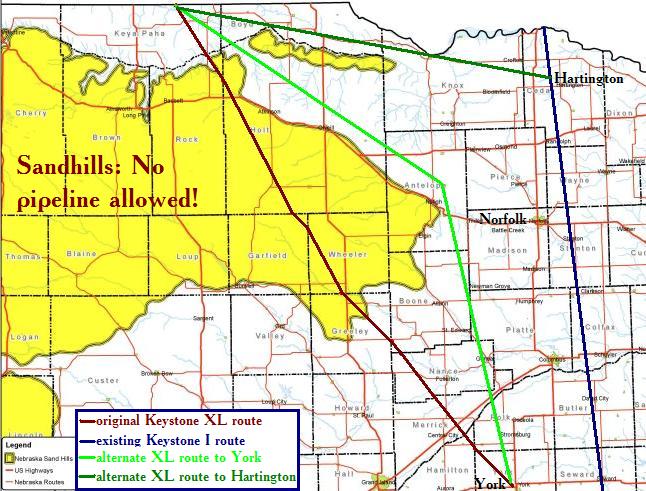
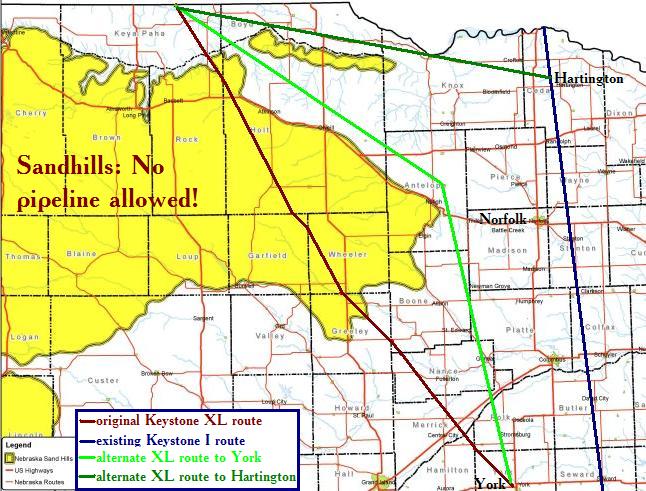
Detail of the Lewis & Clark Nat'l Historical Trail, showing the approximate routes of the existing Keystone I Pipeline (red) and proposed Keystone XL (green).

Detail of the Nebraska portion of the Lewis & Clark N.H.T., showing the approximate routes of the existing Keystone I Pipeline (red) and proposed Keystone XL (green).

As part of the State Department’s review of TransCanada’s proposed Keystone XL Pipeline, 1.2 million comments have been received from interested parties including environmental groups and the public at large. The Department of the Interior has commented too, expressing concern that TransCanada’s impact during construction and during pipeline operation will disrupt the “cultural soundscapes” and “high quality night skies” at national parks and recreation areas distant from the actual route.

Really.

The pipeline won’t pass near the most-visited parks, such as Yellowstone in Wyoming. It will cross the popular Lewis & Clark National Historic Trail, which stretches across 11 states, and the Missouri National Recreational River in South Dakota and Nebraska, which combined draw an average more than 386,000 visitors a year, according to park service data.

Now wait just a second. The Lewis & Clark National Historic Trail is, essentially, the Missouri River. The Trail starts in St. Louis and follows the Big Muddy all the way to the Continental Divide. The Keystone XL route crosses it in eastern Montana, not in Nebraska and not near the Missouri National Recreational River. The dozens of historical sites managed by the National Park Service along the entire dispersed route of the Trail are visited by something just over 0.1% of the U.S. population annually.

(Ironically, the original Keystone I Pipeline, the one already in operation, runs right through the Missouri National Recreational River that the Keystone XL will skirt by 30 miles or more.)
The maps are reproduced at the end of this post.

The Interior Department’s comments faulted the environmental review’s recommendation for noise near pump stations to meet the level common in communities rather than for a park environment “where many people go to get away from the clamor of everyday life.”

And how do they get from their homes to the idyllic national parks, away from the clamor of everyday life? It’s a fair bet most of them get there in planes, trains and automobiles, which run on — that’s right — petroleum products.

We all live near pipelines. For the most part, they are quiet and trouble free, and the safest form of transportation for the fuels that power our “clamorous” lives.

Cross-posted.

USpipelines

Keystone-XL-reroute-mapKeystoneXL-SandhillsDec2011-alts

Posted in Energy, Environment | Tagged , , , | 3 Comments

If you’re going to do a Cult of Personality, there’s no point in doing it halfway.

http://www.dailynk.com/english/read.php?cataId=nk02900&num=10829

The “Ten Principles for the Establishment of the One-Ideology System” are regulations that govern the everyday lives of the North Korean people. They were officially announced by Kim Jong Il in 1974. The original Ten Principles, to which the name “General Kim Jong Il” has now been added, are as follows:

1. We must give our all in the struggle to unify the entire society with the revolutionary ideology of Great Leader Kim Il Sung.

2. We must honor Great Leader comrade Kim Il Sung with all our loyalty.

3. We must make absolute the authority of Great Leader comrade Kim Il Sung.

4. We must make Great Leader comrade Kim Il Sung’s revolutionary ideology our faith and make his instructions our creed.

5. We must adhere strictly to the principle of unconditional obedience in carrying out the Great Leader comrade Kim Il Sung’s instructions.

6. We must strengthen the entire Party’s ideology and willpower and revolutionary unity, centering on Great Leader comrade Kim Il Sung.

7. We must learn from Great Leader comrade Kim Il Sung and adopt the communist look, revolutionary work methods and people-oriented work style.

8. We must value the political life we were given by Great Leader comrade Kim Il Sung, and loyally repay his great political trust and thoughtfulness with heightened political awareness and skill.

9. We must establish strong organizational regulations so that the entire Party, nation and military move as one under the one and only leadership of Great Leader comrade Kim Il Sung.

10. We must pass down the great achievement of the revolution by Great Leader comrade Kim Il Sung from generation to generation, inheriting and completing it to the end.

The ten main principles and 65 sub-clauses of the Ten Principles describe in detail how to go about establishing the one-ideology system. All North Koreans have to memorize them. Not only that, they have to put them into practice; during regular evaluation meetings, people criticize themselves on the basis of whether or not they have been living up to the Ten Principles in their everyday lives.

Posted in Uncategorized | Leave a comment

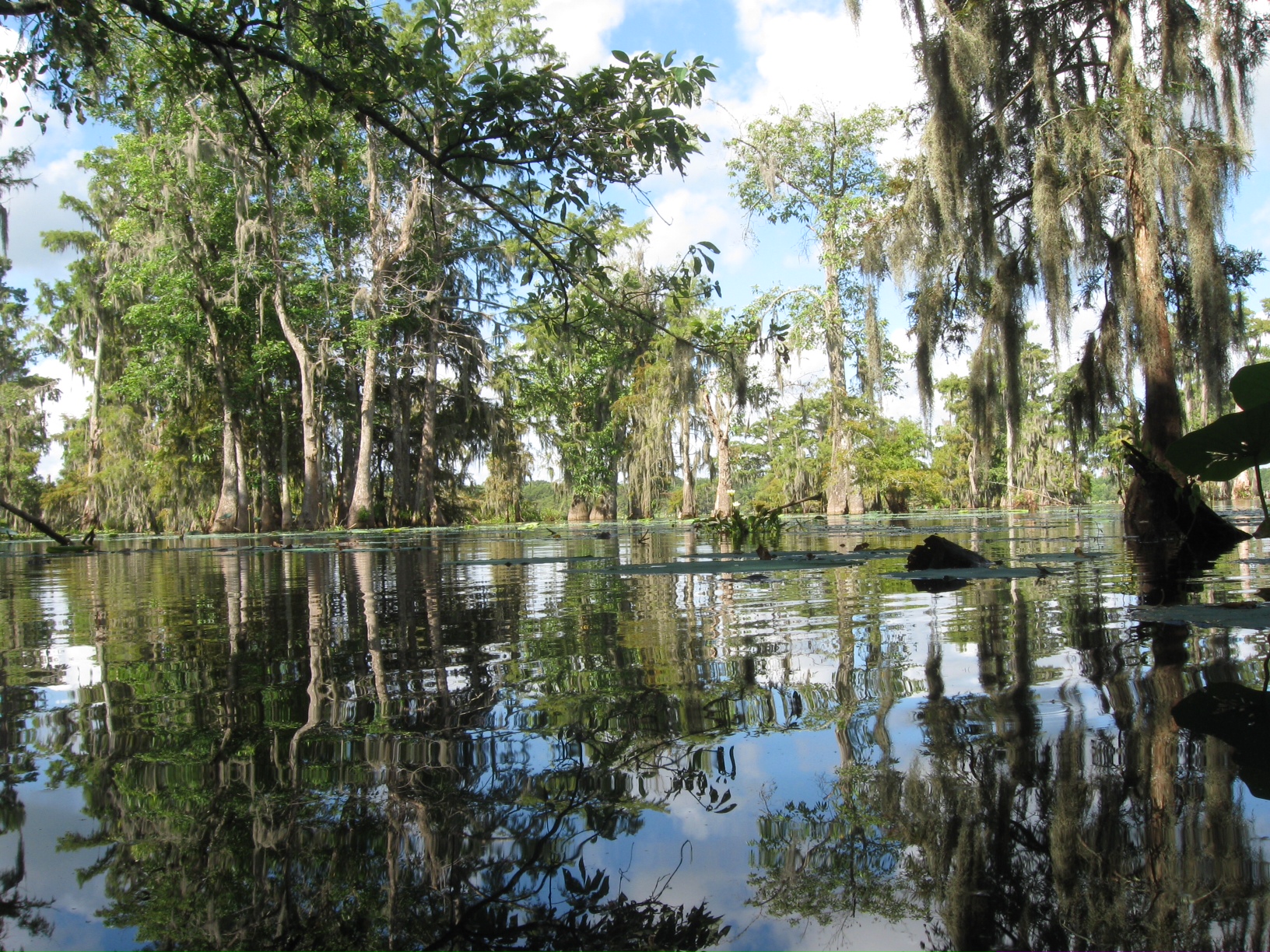
Sunday morning, Lake Martin

Posted in Uncategorized | Leave a comment

40% Growth in Oil and Gas Jobs Since 2007. #oilandgas

From FuelFix.com, the energy blog of the Houston Chronicle:

Jobs in the oil and gas sector have grown 40 percent in the last five years, helping to counteract the tepid one percent increase in total U.S. employment.

The oil and natural gas industry created more than 162,000 jobs from 2007 to 2012 in drilling, extraction and support services, according to a report by the Labor Department’s Bureau of Labor Statistics released Friday.

These new jobs helped build up the ranks of the more than 971,000 people working in the industry in the U.S., including about 379,800 in Texas, …

While the recession and the moratorium had a temporary impact on oil and gas jobs, the dramatic increase of oil and gas production created the need for additional employees. Monthly crude oil production increased 39 percent and natural gas production increased 25 percent during the five year time period, according to the Energy Information Administration.

With our economy still mired in a Jobless Recovery, one can only wonder how many jobs might be possible if we unleashed the job-growth possibilities the oil and gas industry offers.

Cross-posted.

Posted in Economy, Energy | 1 Comment

Senator Harry Reid and Identity Politics

When Senate Majority Leader Harry Reid (D-NV) sees Republican opposition to Obama administration policies, he “hopes” it’s not based in racism.

Believe it or not, it is possible to hold a divergent opinion in good faith. Sometimes, Sen. Reid, a cigar is just a cigar.

South Carolina Sen. Tim Scott, a Republican, called on the [Senate Majority Leader Harry Reid] to apologize after saying during a radio interview on Friday that he hopes Republican opposition to Obama is “based on substance and not the fact that he’s African-American.” (Source.)

In their coverage of Scott’s comments, TheHill.com graces us with this little chestnut:

Scott, who replaced former Sen. Jim DeMint (R-S.C.) in January, is the only African-American member of the Senate Republican Conference. [Emphasis added.]

How’s that again? Scott is the only African American in the Senate, Republican or Democrat.

TheHill’s article also documents Democratic opposition to Obama administration energy policies. We, as good Republicans and loyal opponents, should presume that the opposition from Southern and energy state Democrats is based on substance, not racism:

Sen. Mary Landrieu (D-La.) last month grilled Obama during a private meeting over his administration’s protracted consideration of the [Keystone XL] pipeline, arguing that it has support from a strong majority of the Senate. …

In March, 17 Senate Democrats voted for an amendment sponsored by Sen. John Hoeven (R-N.D.) endorsing the pipeline.

Sens. Mark Begich (D-Alaska), Kay Hagan (D-N.C.), Mark Pryor (D-Ark.) and Landrieu, who all face tough elections next year, voted for the measure, which passed by a margin of 62 to 37. …

Democratic Sen. Joe Manchin (D-W.Va.) in June said Obama had “declared a war on coal” and called his regulatory agenda “not reasonable.”

Sen. Reid, the gulf between the economic policies of the two parties is wider than it has been in recent history. One need not presume racism, or bad faith for that matter, in the Republicans’ opposition to the Redistributionist-in-Chief. Physician, heal thyself.

Posted in Energy, Politics | Tagged , , | Leave a comment

R.I.P. George Duke

“I was in a rock band, I played with a bunch of Brazilians, I played R&B with Parliament-Funkadelic and all of that,” he said in an interview before his most recent album, “DreamWeaver,” was released last month. “I mean, I’ve done jazz with Miles Davis and Cannonball Adderley. It’s a goulash. It’s a gumbo.”

Mr. Duke, who as a small boy begged his mother to buy him a piano after she took him to see Duke Ellington, began playing professionally at a time when many musicians were interested in blending genres. He played in a trio that backed the singer Al Jarreau while he was still a teenager, then accompanied Dizzy Gillespie and other jazz musicians at clubs in San Francisco. By the early 1970s he had performed and recorded with Adderley, the jazz violinist Jean-Luc Ponty and Zappa’s Mothers of Invention. (His long stint with Zappa included an appearance, with the rest of the band, in the feature film “200 Motels.”)

Zappa “told me one day that I should play synthesizers,” Mr. Duke wrote on his Web site. “It was as simple as that!” Urged by Zappa, he said, he experimented with a few types of synthesizers before settling on the ARP Odyssey, “purely to be different from Jan Hammer, who was playing the Minimoog.” Mr. Hammer was a member of the guitarist John McLaughlin’s Mahavishnu Orchestra, one of the first jazz-rock fusion bands to achieve widespread success.

http://www.nytimes.com/2013/08/07/arts/music/george-duke-crossover-musician-with-frank-zappa-dies-at-67.html

Posted in Uncategorized | Leave a comment