
Dig the moats, unroll the concertina wire and man the battlements! With the looming possibility of $4.00 per gallon gasoline at the pump, the Left’s defense of President Obama’s disastrous energy policies has begun in earnest.
Matt Yglesias unfurled the narrative at Slate.com:
Out of Gas, The folly of blaming Obama for higher gas prices.
…[T]his should all serve as a reminder that there’s little constructive action the American government can take to lower the price of gasoline. What’s more, while voters would obviously prefer cheaper gas to more expensive gas, there’s little reason to believe that expensive oil per se is a sign of political trouble for the president.
Last—but by no means least—it can’t be emphasized enough that gasoline is actually unusually cheap in the United States in a way that’s problematic for our economy over the long run.
… there’s little constructive action the American government can take to lower the price of gasoline … I rebutted this talking point in my last post, so I needn’t belabor it. From leasing to taxation to regulation, the Obama Administration’s energy policies have been uniformly in the direction of restricting supply. The price of crude oil is set on a world marketplace where supply and demand are in precarious balance. As the world’s #3 oil producer, policy decisions in the US certainly matter.
Stability in crude oil markets is achieved when there is roughly a 1 to 2 million barrel per day “overhang” in supply. For illustrative purposes, let’s say worldwide demand is 85 million barrels per day; with production capacity of 86 to 87 million barrels, there is sufficient market flexibility to cover for minor regional supply disruptions.
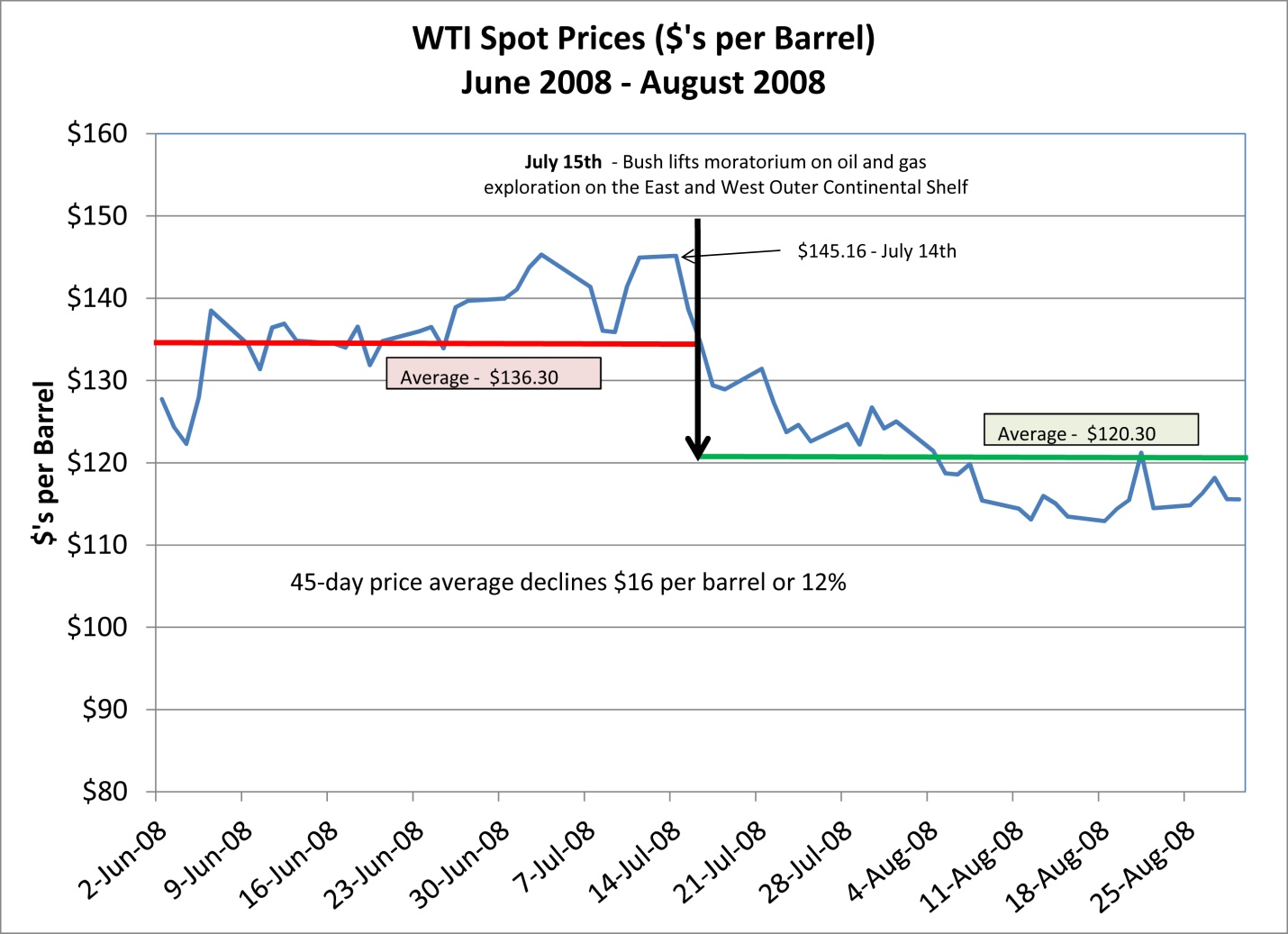
If there’s a sudden oversupply (or drop in demand), the price can drop sharply because the excess oil must be stored at a cost. Lacking a market, the value of an incremental barrel is low. We saw this happen when worldwide demand eroded by ~2 million barrels per day during the economic meltdown. Oil plunged from $145/bbl to $36/bbl over the course of a few months.
Conversely, if demand grows by 0.5 to 1 million bbls/day without supply gains, the price can shoot up rapidly. As that market cushion erodes, buyers get nervous and bid up the price.
The President’s decisions can affect supply in 500,000 bbl/day “chunks”. Offshore regulation and the Keystone XL Pipeline are two examples.
Back to Mr. Yglesias: “…there’s little reason to believe that expensive oil per se is a sign of political trouble for the president.”
Talk about “whistling past the graveyard.” $4.00/gal is an important psychological barrier in people’s minds. Few realize that they paid more for gasoline 2011 than in 2008, because they have such vivid memories of 2008’s painful but brief spikes over $4.00.
“… gasoline is actually unusually cheap in the United States in a way that’s problematic for our economy over the long run.”
Holy cow. That’s a new one the voters will love: “Take your medicine, schlubs. It’s good for you.”
In other words, cheap fossil fuels stifle development of “green” energy sources. We should be like the enlightened Europeans, who place outrageous taxes on gasoline, thereby forcing their people into mini-diesels and mass transportation.
To back up a claim that the Keystone XL Pipeline will increase, not decrease gasoline prices, Yglesias links to blogger George Zornick in The Nation, who in turn invokes the authority of ardent Keystone opponent and Global Warming alarmist Bill McKibben at The Hill. McKibben notes that a glut of “tarsands crude” (sic) in the huge tank farms at Cushing OK is keeping midwestern gasoline prices low, and that Keystone would undo all of that while profiting the greedy pipeline owner TransCanada.
Gasoline in Denver, at $3.03/gal, is the cheapest in the nation. The 20% or so of Americans who live in the interior benefit from this landlocked “West Texas Intermediate” (WTI) oil, currently priced at $106 per barrel, versus the world price nearer $123. That’s how much we’re receiving for oil here on the Gulf Coast, where the product can be traded into the world market.
Here’s the key: the world price dictates the price of gasoline for the 80% of Americans who are not landlocked. If you live in New York, or Philadelphia, or Washington, Atlanta, Houston or San Francisco, your gasoline price is based on the $123 price of Brent North Sea crude, not $106 WTI.
And if that glut of WTI could access the world market, it do so in sufficient quantity (~500,000 bbls/day) to drive the world price down. How much is up to the market to decide, but a half million barrels a day matters.
It doesn’t take much business sense to know that any system works better if you relieve its bottlenecks. The current bottleneck in the system is the inability to move midcontinent oil to the Gulf Coast where it could enter the world market. And that’s one reason the Keystone XL is important.
So here we have a Lefty narrative in the making: Yglesias’ authority is Zornick, who quotes McKibben. McKibben is not an energy economist, he’s an environmental activist; he thinks low gasoline prices are bad for you because polar bears and melting glaciers. McKibben’s goal is high prices which make alternative fuels (if they exist) more competitive.
Of course Yglesias, McKibben et al argue that the President is not to blame. They’ll do or say anything to re-elect him. Of course they’re arguing that the Keystone XL delay and all his other boneheaded energy decisions don’t matter. In the end, they want higher gasoline prices and ultimately the end of fossil fuels.
Cross-posted at RedState.com.


 Maley's Energy Blog